Secondary spill containment: Difference between revisions
CSV import |
CSV import |
||
| Line 32: | Line 32: | ||
[[Category:Safety engineering]] | [[Category:Safety engineering]] | ||
{{safety-stub}} | {{safety-stub}} | ||
== Secondary spill containment == | |||
<gallery> | |||
File:Big_fuel_bladder_--_Antarctica_--_Byrd_Field_Camp.jpg|Big fuel bladder -- Antarctica -- Byrd Field Camp | |||
File:Secondary-Oil-Containment-Installation.jpg|Secondary Oil Containment Installation | |||
File:Spill_Berms_AIRE_Industrial.jpg|Spill Berms AIRE Industrial | |||
</gallery> | |||
Latest revision as of 00:55, 27 February 2025
Secondary spill containment refers to the methods and practices used to capture and contain spills of hazardous materials to prevent them from spreading into the environment. This containment is considered a critical safety and environmental protection measure in various industries, including chemical manufacturing, oil and gas production, and transportation of hazardous materials. Secondary spill containment systems are designed to catch leaks, drips, or spills that escape primary containment solutions, such as tanks or drums.
Overview[edit]
The primary goal of secondary spill containment is to create a barrier between hazardous substances and the environment. This is achieved by using physical structures, such as containment berms, spill pallets, and containment basins, which are designed to hold a specific volume of liquid. The capacity of these containment systems is typically determined based on the volume of the primary container and regulatory requirements, often requiring the system to hold a certain percentage of the total volume of the primary containers or the volume of the largest container, whichever is greater.
Regulations[edit]
In many countries, the implementation of secondary spill containment measures is mandated by environmental protection laws and regulations. In the United States, the Environmental Protection Agency (EPA) outlines secondary containment requirements under the Resource Conservation and Recovery Act (RCRA), specifically in 40 CFR part 264. The Occupational Safety and Health Administration (OSHA) also has regulations that require secondary containment in certain circumstances to protect workers from hazardous substance exposure.
Types of Secondary Spill Containment[edit]
There are several types of secondary spill containment systems, each suited to different needs and applications:
- Containment Berms: Portable barriers that can be deployed around a potential spill site. They are often used in oil fields and chemical plants.
- Spill Pallets: Platforms with built-in containment sumps designed to hold containers, such as drums or totes, preventing any leaks from spreading.
- Containment Basins: Large, fixed structures used to enclose areas where large volumes of hazardous materials are stored or handled.
- Double-Walled Tanks: Tanks with an outer wall that serves as secondary containment for the inner tank, commonly used for petroleum and chemical storage.
Selection Criteria[edit]
When selecting a secondary spill containment system, several factors must be considered to ensure it meets the needs of the application and complies with regulatory requirements. These factors include:
- Material Compatibility: The containment system must be resistant to the chemicals it is intended to contain.
- Capacity: The system must have sufficient capacity to contain the required volume of liquid in case of a spill.
- Durability: The materials used in the containment system should be durable enough to withstand the conditions of the environment where it is used.
- Ease of Deployment and Use: Especially important for portable containment solutions, such as berms.
Environmental and Safety Benefits[edit]
Implementing effective secondary spill containment measures can significantly reduce the risk of environmental pollution and protect wildlife. It also minimizes the risk of exposure to hazardous substances for workers and the public, contributing to safer work environments and communities.
Conclusion[edit]
Secondary spill containment is a vital component of environmental protection and workplace safety in industries that handle hazardous materials. By preventing spills from reaching the environment, these systems play a crucial role in mitigating the impact of industrial activities on the planet and human health.

This safety related article is a stub. You can help WikiMD by expanding it.
Secondary spill containment[edit]
-
 Big fuel bladder -- Antarctica -- Byrd Field Camp
 -
 Secondary Oil Containment Installation
 -
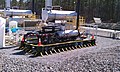 Spill Berms AIRE Industrial


