Diner lingo: Difference between revisions
CSV import |
CSV import |
||
| Line 26: | Line 26: | ||
[[Category:Restaurant terminology]] | [[Category:Restaurant terminology]] | ||
{{linguistics-stub}} | {{linguistics-stub}} | ||
<gallery> | |||
File:SalemDiner_Salem_Massachusetts.jpg|Salem Diner in Salem, Massachusetts | |||
File:Two_poached_eggs_on_toast.jpg|Two poached eggs on toast | |||
File:Corned_beef_hash.jpg|Corned beef hash | |||
</gallery> | |||
Latest revision as of 02:05, 18 February 2025
Diner lingo is a form of American English slang used by waitstaff and cooks in diners and restaurants. It is characterized by its unique terms, phrases, and abbreviations, many of which originated in the early 20th century. Diner lingo was developed as a means of efficient and entertaining communication between kitchen staff and servers in the noisy, fast-paced diner environment. This article explores the origins, examples, and the decline of diner lingo in contemporary dining culture.
Origins[edit]
Diner lingo emerged in the United States during the early 1900s, a time when diners and small, fast-service restaurants began to proliferate across the country. These establishments, often open 24 hours, required a quick and efficient means of communication between the waitstaff and the cooks. Diner lingo evolved as a shorthand to quickly convey orders, with the added benefit of amusing customers and creating a unique dining experience.
Examples[edit]
Diner lingo includes a wide variety of terms, some of which are still recognized today, while others have fallen out of use. Here are a few examples:
- Adam and Eve on a raft – Two poached eggs on toast.
- Burn one, take it through the garden and pin a rose on it – A hamburger with lettuce, tomato, and onion.
- Cowboy with spurs – A western omelette with French fries.
- Shingle with a shimmy and a shake – Buttered toast with jelly or jam.
- Two cows, make them cry – Two hamburgers with onions.
- Wreck 'em – Scrambled eggs.
Decline[edit]
The use of diner lingo has declined significantly since its mid-20th century heyday. Factors contributing to this decline include the standardization of restaurant operations, the advent of computerized ordering systems, and changes in diner culture. While some terms are still used in certain establishments, much of the original lingo has been lost or is used more for novelty than necessity.
Contemporary Use[edit]
Today, diner lingo is often encountered in a historical or nostalgic context. Some diners, particularly those that aim to recreate a mid-20th century atmosphere, continue to use and celebrate diner lingo as part of the dining experience. It is also a subject of interest among linguists and cultural historians who study the evolution of language and slang in American culture.
Conclusion[edit]
Diner lingo serves as a fascinating example of occupational slang, reflecting the creativity, humor, and efficiency of diner staff throughout the 20th century. While its practical use has diminished, the charm and wit of diner lingo continue to captivate those interested in American diner culture and the evolution of language.

This article is a linguistics stub. You can help WikiMD by expanding it!
-
 Salem Diner in Salem, Massachusetts
 -
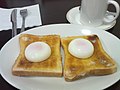 Two poached eggs on toast
 -
 Corned beef hash


