United States Code: Difference between revisions
CSV import Tags: mobile edit mobile web edit |
CSV import |
||
| (One intermediate revision by the same user not shown) | |||
| Line 1: | Line 1: | ||
{{Use mdy dates|date=October 2023}} | |||
{{Short description|Codification of the general and permanent laws of the United States}} | |||
The '''United States Code''' ( | [[File:Great Seal of the United States (obverse).svg|thumb|right|The Great Seal of the United States]] | ||
[[File:United States Code 2012 Official Edition.jpg|thumb|right|The 2012 official edition of the United States Code]] | |||
[[File:Uscatitle11.jpg|thumb|right|Title 11 of the United States Code]] | |||
The '''United States Code''' ('''U.S.C.''') is the official compilation and codification of the general and permanent [[federal statutes]] of the [[United States]]. It contains 54 titles and is published by the [[Office of the Law Revision Counsel]] of the [[United States House of Representatives]]. | |||
==History== | |||
The need for a comprehensive codification of federal statutes was recognized in the early 20th century. Prior to the creation of the United States Code, federal statutes were published in the form of individual "slip laws" and later compiled into the [[Statutes at Large]]. The first edition of the United States Code was published in 1926. | |||
==Structure== | ==Structure== | ||
The | The United States Code is divided into titles based on subject matter. Each title is further divided into sections. The Code is updated periodically to incorporate new laws and amendments. The official version is published every six years, with annual cumulative supplements. | ||
==Legal | ==Legal status== | ||
The United States Code | The United States Code is not a legal document in itself but a compilation of the laws. The [[Statutes at Large]] remain the official legal authority. However, the Code is recognized as prima facie evidence of the laws of the United States. | ||
== | ==Publication and updates== | ||
The | The Office of the Law Revision Counsel is responsible for preparing and publishing the United States Code. The Code is available in both print and electronic formats. The electronic version is updated more frequently and is accessible online. | ||
== | ==Related pages== | ||
* [[Statutes at Large]] | |||
* [[Code of Federal Regulations]] | |||
* [[Federal Register]] | |||
== | ==References== | ||
* "United States Code." Office of the Law Revision Counsel, U.S. House of Representatives. Accessed October 2023. | |||
* "About the United States Code." Office of the Law Revision Counsel, U.S. House of Representatives. Accessed October 2023. | |||
[[Category:United States federal | [[Category:United States federal law]] | ||
[[Category:Legal | [[Category:Legal codes]] | ||
<gallery> | |||
File:Great_Seal_of_the_United_States_(obverse).svg|Great Seal of the United States | |||
File:United_States_Code_2012_Official_Edition.jpg|United States Code 2012 Official Edition | |||
File:Uscatitle11.jpg|United States Code Title 11 | |||
</gallery> | |||
Latest revision as of 04:06, 18 February 2025
Codification of the general and permanent laws of the United States
.svg)


The United States Code (U.S.C.) is the official compilation and codification of the general and permanent federal statutes of the United States. It contains 54 titles and is published by the Office of the Law Revision Counsel of the United States House of Representatives.
History[edit]
The need for a comprehensive codification of federal statutes was recognized in the early 20th century. Prior to the creation of the United States Code, federal statutes were published in the form of individual "slip laws" and later compiled into the Statutes at Large. The first edition of the United States Code was published in 1926.
Structure[edit]
The United States Code is divided into titles based on subject matter. Each title is further divided into sections. The Code is updated periodically to incorporate new laws and amendments. The official version is published every six years, with annual cumulative supplements.
Legal status[edit]
The United States Code is not a legal document in itself but a compilation of the laws. The Statutes at Large remain the official legal authority. However, the Code is recognized as prima facie evidence of the laws of the United States.
Publication and updates[edit]
The Office of the Law Revision Counsel is responsible for preparing and publishing the United States Code. The Code is available in both print and electronic formats. The electronic version is updated more frequently and is accessible online.
Related pages[edit]
References[edit]
- "United States Code." Office of the Law Revision Counsel, U.S. House of Representatives. Accessed October 2023.
- "About the United States Code." Office of the Law Revision Counsel, U.S. House of Representatives. Accessed October 2023.
-
 Great Seal of the United States
 -
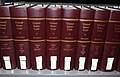 United States Code 2012 Official Edition
 -
 United States Code Title 11
