University of Brighton: Difference between revisions
CSV import Tags: mobile edit mobile web edit |
CSV import |
||
| (One intermediate revision by the same user not shown) | |||
| Line 1: | Line 1: | ||
{{Use dmy dates|date=October 2023}} | |||
{{Use British English|date=October 2023}} | |||
[[File:Checkland-building-falmer-faculty-of-arts-university-of-brighton.jpg|thumb|Checkland Building, Falmer Campus]] | |||
[[File:University_of_Brighton_Faculty_of_Art_and_Design,_Grand_Parade,_Brighton_(November_2015).JPG|thumb|Grand Parade, Faculty of Art and Design]] | |||
[[File:Cockcroft_Building,_University_of_Brighton,_Lewes_Road,_Brighton_(seen_from_Birling_Close_footpath).JPG|thumb|Cockcroft Building, Lewes Road]] | |||
[[File:Mithras_House_(University_of_Brighton),_Lewes_Road,_Brighton_(December_2012)_(2).JPG|thumb|Mithras House, Lewes Road]] | |||
The '''University of Brighton''' is a public university located on the south coast of England, with campuses in [[Brighton]] and [[Eastbourne]]. It was established in 1858 as the Brighton School of Art and gained university status in 1992. | |||
==History== | ==History== | ||
The origins of the University of Brighton | The origins of the University of Brighton can be traced back to 1858 when the Brighton School of Art was founded. Over the years, it expanded and merged with other institutions, eventually becoming Brighton Polytechnic in 1970. In 1992, it was granted university status and became the University of Brighton. | ||
==Campuses== | ==Campuses== | ||
The | The university has several campuses: | ||
* '''Falmer Campus''': Located on the outskirts of Brighton, this campus houses the School of Education and the School of Humanities. The Checkland Building is a notable feature of this campus. | |||
* '''Grand Parade Campus''': Situated in the city center, it is home to the Faculty of Arts and Humanities. The Grand Parade building is a key part of this campus. | |||
* '''Moulsecoomb Campus''': This is the largest campus and includes the Cockcroft Building and Mithras House. It hosts the School of Computing, Engineering and Mathematics, among others. | |||
* '''Eastbourne Campus''': Located in the nearby town of Eastbourne, this campus focuses on sports and health sciences. | |||
== | ==Academic Structure== | ||
The University of Brighton is organized into several schools and faculties, including: | |||
* School of Applied Social Science | |||
* School of Architecture and Design | |||
* School of Art | |||
* School of Business and Law | |||
* School of Computing, Engineering and Mathematics | |||
* School of Education | |||
* School of Environment and Technology | |||
* School of Health Sciences | |||
* School of Humanities | |||
* School of Media | |||
== | ==Research== | ||
The | The university is involved in a wide range of research activities, with particular strengths in areas such as art and design, health, and engineering. It has several research centers and institutes that focus on interdisciplinary research. | ||
==Student Life== | ==Student Life== | ||
The University of Brighton offers a vibrant student life with numerous clubs and societies. The Students' Union provides support and organizes events throughout the year. | |||
==Notable Alumni== | ==Notable Alumni== | ||
The | The university has produced many notable alumni, including: | ||
* [[Norman Cook]] (Fatboy Slim), musician and DJ | |||
* [[Chris Barrie]], actor and comedian | |||
* [[Piers Morgan]], journalist and television presenter | |||
== | ==Related pages== | ||
* [[Brighton]] | |||
* [[Eastbourne]] | |||
* [[Higher education in the United Kingdom]] | |||
==References== | |||
{{Reflist}} | |||
[[Category:University of Brighton| ]] | |||
<gallery> | |||
File:Checkland-building-falmer-faculty-of-arts-university-of-brighton.jpg|Checkland Building, Falmer, Faculty of Arts, University of Brighton | |||
File:University_of_Brighton_Faculty_of_Art_and_Design,_Grand_Parade,_Brighton_(November_2015).JPG|University of Brighton Faculty of Art and Design, Grand Parade, Brighton | |||
File:Cockcroft_Building,_University_of_Brighton,_Lewes_Road,_Brighton_(seen_from_Birling_Close_footpath).JPG|Cockcroft Building, University of Brighton, Lewes Road, Brighton | |||
File:Mithras_House_(University_of_Brighton),_Lewes_Road,_Brighton_(December_2012)_(2).JPG|Mithras House, University of Brighton, Lewes Road, Brighton | |||
</gallery> | |||
Latest revision as of 11:27, 18 February 2025

.JPG)
.JPG)
,_Lewes_Road,_Brighton_(December_2012)_(2).JPG)
The University of Brighton is a public university located on the south coast of England, with campuses in Brighton and Eastbourne. It was established in 1858 as the Brighton School of Art and gained university status in 1992.
History[edit]
The origins of the University of Brighton can be traced back to 1858 when the Brighton School of Art was founded. Over the years, it expanded and merged with other institutions, eventually becoming Brighton Polytechnic in 1970. In 1992, it was granted university status and became the University of Brighton.
Campuses[edit]
The university has several campuses:
- Falmer Campus: Located on the outskirts of Brighton, this campus houses the School of Education and the School of Humanities. The Checkland Building is a notable feature of this campus.
- Grand Parade Campus: Situated in the city center, it is home to the Faculty of Arts and Humanities. The Grand Parade building is a key part of this campus.
- Moulsecoomb Campus: This is the largest campus and includes the Cockcroft Building and Mithras House. It hosts the School of Computing, Engineering and Mathematics, among others.
- Eastbourne Campus: Located in the nearby town of Eastbourne, this campus focuses on sports and health sciences.
Academic Structure[edit]
The University of Brighton is organized into several schools and faculties, including:
- School of Applied Social Science
- School of Architecture and Design
- School of Art
- School of Business and Law
- School of Computing, Engineering and Mathematics
- School of Education
- School of Environment and Technology
- School of Health Sciences
- School of Humanities
- School of Media
Research[edit]
The university is involved in a wide range of research activities, with particular strengths in areas such as art and design, health, and engineering. It has several research centers and institutes that focus on interdisciplinary research.
Student Life[edit]
The University of Brighton offers a vibrant student life with numerous clubs and societies. The Students' Union provides support and organizes events throughout the year.
Notable Alumni[edit]
The university has produced many notable alumni, including:
- Norman Cook (Fatboy Slim), musician and DJ
- Chris Barrie, actor and comedian
- Piers Morgan, journalist and television presenter
Related pages[edit]
References[edit]
<references group="" responsive="1"></references>
-
 Checkland Building, Falmer, Faculty of Arts, University of Brighton
 -
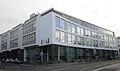 University of Brighton Faculty of Art and Design, Grand Parade, Brighton
 -
 Cockcroft Building, University of Brighton, Lewes Road, Brighton
 -
 Mithras House, University of Brighton, Lewes Road, Brighton
