Standard Model: Difference between revisions
CSV import Tags: mobile edit mobile web edit |
CSV import |
||
| Line 13: | Line 13: | ||
{{physics-stub}} | {{physics-stub}} | ||
<gallery> | |||
File:Standard_Model.svg|Standard Model | |||
File:Standard_Model_–_All_Feynman_diagram_vertices.svg|All Feynman diagram vertices | |||
File:Fundamental_Interactions.png|Fundamental Interactions | |||
</gallery> | |||
Latest revision as of 03:51, 18 February 2025

The Standard Model of particle physics is a theory that describes three of the four known fundamental forces in the universe, as well as classifying all known elementary particles. It is a quantum field theory that is consistent with both quantum mechanics and special relativity, and it has been tested by numerous experiments, making it one of the most successful theories in physics.
The Standard Model includes the electromagnetic, weak, and strong nuclear forces, but it does not include gravity, which is described by general relativity. The particles in the Standard Model include twelve fermions, which are the building blocks of matter, and twelve bosons, which mediate the forces between fermions. The fermions are divided into six quarks and six leptons, including the electron and the neutrino. The bosons include the photon, which mediates the electromagnetic force; the W and Z bosons, which mediate the weak force; and the gluons, which mediate the strong force. The Higgs boson, discovered in 2012, is also part of the Standard Model and is associated with the Higgs field, which gives mass to other particles.
Despite its success, the Standard Model is not complete. It does not explain the gravitational force, the dark matter and dark energy that make up most of the universe, or why there is more matter than antimatter in the universe. Theories such as supersymmetry, string theory, and quantum gravity are being developed to extend the Standard Model and address these mysteries.

-
 Standard Model
 -
 All Feynman diagram vertices
 -
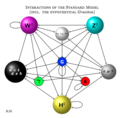 Fundamental Interactions


