Chlorodifluoromethane: Difference between revisions
CSV import |
CSV import |
||
| Line 28: | Line 28: | ||
[[Category:Refrigerants]] | [[Category:Refrigerants]] | ||
{{Chemistry-stub}} | {{Chemistry-stub}} | ||
<gallery> | |||
File:Liquid_R-22.png|Liquid R-22 | |||
File:R22_-_Chlorodifluoromethane_Cylinder.png|R22 - Chlorodifluoromethane Cylinder | |||
File:HCFC-22_mm.png|HCFC-22 Molecular Model | |||
File:HCFC22_concentration.jpg|HCFC-22 Concentration | |||
File:Container_【_2?T?_】_GRPU_918195(3)---No,2_【_Pictures_taken_in_Japan_】.jpg|Chlorodifluoromethane | |||
File:R22_ph.gif|R22 Pressure-Temperature Chart | |||
File:Refrigerants-Prices-Wikipedia-2016-08-25.svg|Refrigerants Prices | |||
</gallery> | |||
Latest revision as of 11:15, 18 February 2025

Chlorodifluoromethane, also known by its IUPAC name difluoromonochloromethane or under the trade name Freon-22 (R-22), is a hydrochlorofluorocarbon (HCFC) used primarily as a refrigerant. Produced by the fluorination of chloromethane, chlorodifluoromethane has been widely used in air conditioning and refrigeration systems for several decades. However, due to its ozone depletion potential (ODP) and its contribution to climate change as a potent greenhouse gas, its use is being phased out under the terms of the Montreal Protocol and its amendments.
Properties[edit]
Chlorodifluoromethane is a colorless, non-flammable gas at room temperature and has a slight odor. It is moderately soluble in water but more soluble in organic solvents. The compound has a molecular formula of CHClF2 and a molecular weight of 86.47 g/mol. Its boiling point at atmospheric pressure is -40.8 °C, making it suitable for use in low-temperature applications.
Applications[edit]
Historically, chlorodifluoromethane has been utilized in a variety of cooling applications, including residential and automotive air conditioning systems, commercial refrigeration, and industrial cooling processes. It has also been used as a blowing agent for foam plastics and in the manufacture of packaging materials.
Environmental Impact[edit]
Chlorodifluoromethane contributes to both ozone layer depletion and global warming. Its ozone depletion potential (ODP) is 0.055, indicating that it is less harmful to the ozone layer than some other chlorofluorocarbons (CFCs), but still significant. Additionally, it has a global warming potential (GWP) of 1810 over a 100-year period, which means it is much more effective at trapping heat in the atmosphere than carbon dioxide on a per-molecule basis.
Due to these environmental concerns, the production and consumption of chlorodifluoromethane are being phased out worldwide under the Montreal Protocol. Alternatives with lower ODP and GWP, such as hydrofluorocarbons (HFCs) and hydrofluoroolefins (HFOs), are being developed and adopted.
Health and Safety[edit]
Exposure to chlorodifluoromethane can occur through inhalation, skin contact, or eye contact. At high concentrations, it can cause dizziness, narcosis, and cardiac arrhythmia. It is also a mild irritant to the skin and eyes. Safety measures include using proper personal protective equipment (PPE) and ensuring adequate ventilation in areas where chlorodifluoromethane is used or stored.
Regulation[edit]
The use, handling, and disposal of chlorodifluoromethane are regulated under various international, national, and local laws due to its environmental and health impacts. The Montreal Protocol plays a key role in the international regulation of substances like chlorodifluoromethane that deplete the ozone layer.
See Also[edit]

-
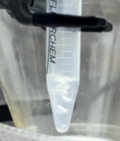 Liquid R-22
 -
 R22 - Chlorodifluoromethane Cylinder
 -
 HCFC-22 Molecular Model
 -
 HCFC-22 Concentration
 -
 Chlorodifluoromethane
 -
 R22 Pressure-Temperature Chart
 -
 Refrigerants Prices


---No,2_%E3%80%90_Pictures_taken_in_Japan_%E3%80%91.jpg)


