Coriaria myrtifolia: Difference between revisions
CSV import |
CSV import |
||
| Line 25: | Line 25: | ||
{{botany-stub}} | {{botany-stub}} | ||
== Coriaria myrtifolia == | |||
<gallery> | |||
File:Roldor0032.JPG|Coriaria myrtifolia foliage | |||
File:Coriaria_myrtifolia_MHNT.BOT.2009.17.19.jpg|Coriaria myrtifolia herbarium specimen | |||
File:Flor_roldor.JPG|Coriaria myrtifolia flower | |||
</gallery> | |||
Latest revision as of 02:11, 18 February 2025

Coriaria myrtifolia, commonly known as the Redoul or Myrtle-leaved Sumach, is a species of flowering plant in the family Coriariaceae. It is native to the western Mediterranean region, extending from Spain and Portugal through southern France and Italy to the Balkans. The plant is notable for its attractive foliage and small, dark purple fruits, which are highly toxic to humans and animals.
Description[edit]
Coriaria myrtifolia is a deciduous shrub that can grow up to 2 meters in height. Its leaves are simple, opposite, and have a myrtle-like appearance, hence the name myrtifolia. The flowers are small, greenish, and arranged in racemes. They bloom in spring and are followed by the formation of small, round, dark purple fruits in the summer. Each fruit contains several seeds.
Habitat and Distribution[edit]
Coriaria myrtifolia prefers well-drained soils and is commonly found in woodlands, scrub areas, and along riverbanks. Its native range covers the western Mediterranean region. The plant has also been observed in some parts of North Africa.
Toxicity[edit]
All parts of Coriaria myrtifolia, especially the fruits, contain toxic compounds. Ingestion of the fruits can lead to severe poisoning, characterized by symptoms such as vomiting, diarrhea, convulsions, and in extreme cases, death. Due to its toxicity, caution is advised when planting Coriaria myrtifolia in areas accessible to children and pets.
Cultural Significance[edit]
Despite its toxicity, Coriaria myrtifolia has been used in traditional medicine in some cultures to treat various ailments. However, due to the risk of poisoning, its use is not recommended without proper knowledge and guidance from a qualified professional.
Conservation Status[edit]
Currently, Coriaria myrtifolia does not appear on the IUCN Red List of Threatened Species. It is relatively widespread and common within its native range. However, habitat destruction and climate change could pose future threats to its populations.
See Also[edit]

Coriaria myrtifolia[edit]
-
 Coriaria myrtifolia foliage
 -
 Coriaria myrtifolia herbarium specimen
 -
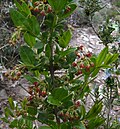 Coriaria myrtifolia flower


