Comparative foot morphology: Difference between revisions
CSV import |
CSV import Tags: mobile edit mobile web edit |
||
| Line 26: | Line 26: | ||
[[Category:Evolutionary biology]] | [[Category:Evolutionary biology]] | ||
{{anatomy-stub}} | {{anatomy-stub}} | ||
<gallery> | |||
File:Comparative_view_of_the_human_and_elephant_frame,_Benjamin_Waterhouse_Hawkins,_1860.jpg|Comparative view of the human and elephant frame | |||
File:Elephant_skeleton.jpg|Elephant skeleton | |||
File:Panthera_leo_limbs.png|Panthera leo limbs | |||
File:Mm_Fuß.jpg|Comparative foot morphology | |||
File:Indischer_Elefant_Detail_Füße.JPG|Indischer Elefant Detail Füße | |||
File:DogDewClawTika1_wb.jpg|Dog dew claw | |||
File:Hufschnitt.jpg|Hufschnitt | |||
File:PSM_V04_D550_Elephant_rear_leg_bones.jpg|Elephant rear leg bones | |||
File:Primatenskelett-drawing.jpg|Primatenskelett drawing | |||
</gallery> | |||
Latest revision as of 12:03, 18 February 2025
Comparative foot morphology involves the study of the structure, function, and evolutionary differences in the feet of various species. This field encompasses a broad range of disciplines including anatomy, physiology, evolutionary biology, and biomechanics. The morphology of the foot is crucial for understanding how different organisms move, interact with their environment, and how these features have evolved over time.
Overview[edit]
The foot is a complex structure that serves as the primary contact point with the ground for most terrestrial organisms. It is involved in supporting the body's weight, absorbing shock, and providing leverage for movement. In comparative foot morphology, the focus is on the differences and similarities in the foot structure across different species, including humans (Homo sapiens), other primates, birds (Aves), and other mammals.
Human Foot[edit]
The human foot is uniquely adapted for bipedal locomotion, featuring a longitudinal arch that provides shock absorption and efficiency in walking and running. The structure of the human foot includes 26 bones, 33 joints, and more than 100 muscles, tendons, and ligaments. Key components include the tarsal bones, metatarsal bones, and phalanges.
Primate Feet[edit]
Other primates, such as chimpanzees and gorillas, have feet more adapted for grasping and climbing. Their feet are more similar to human hands, with opposable big toes that allow for gripping branches. This feature is indicative of their arboreal lifestyle.
Avian Feet[edit]
Birds have a wide variety of foot types, each adapted to their unique lifestyle and environment. For example, eagles and hawks have powerful talons for grasping prey, while ducks and swans have webbed feet for swimming. The structure of bird feet is significantly different from that of mammals, with variations in the number of toes and their orientation.
Mammalian Feet[edit]
Among mammals, foot morphology varies widely. Ungulates, for example, have evolved hooves that allow for efficient movement over hard ground. Carnivores like lions and wolves have claws and pads that aid in hunting and stealth. The diversity in mammalian foot morphology reflects the wide range of habitats and lifestyles.
Evolutionary Perspective[edit]
Comparative foot morphology provides insights into the evolutionary adaptations of different species. The structure of the foot can reveal a lot about an organism's evolutionary history, including its ancestors, lifestyle, and environmental adaptations. For example, the transition from arboreal to bipedal locomotion in early humans is a significant area of study within this field.
Conclusion[edit]
The study of comparative foot morphology offers valuable insights into the functional adaptations, evolutionary history, and ecological niches of various species. By understanding the differences and similarities in foot structure, scientists can gain a deeper understanding of the complex interactions between organisms and their environments.

-
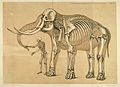 Comparative view of the human and elephant frame
 -
 Elephant skeleton
 -
 Panthera leo limbs
 -
 Comparative foot morphology
 -
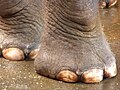 Indischer Elefant Detail Füße
 -
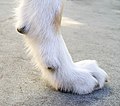 Dog dew claw
 -
 Hufschnitt
 -
 Elephant rear leg bones
 -
 Primatenskelett drawing


