List of minerals: Difference between revisions
CSV import Tags: mobile edit mobile web edit |
CSV import |
||
| Line 33: | Line 33: | ||
{{Geology-stub}} | {{Geology-stub}} | ||
== List of minerals gallery == | |||
<gallery> | |||
File:(61-365) Can you imagine? (5320329773).jpg|Can you imagine? | |||
File:Apophyllite-(KF)-Stilbite-Ca-118260.jpg|Apophyllite-(KF)-Stilbite-Ca | |||
File:Aquamarine J1.JPG|Aquamarine | |||
File:Arsenopyrite-117874.jpg|Arsenopyrite | |||
File:Aurichalcite-Hemimorphite-230159.jpg|Aurichalcite-Hemimorphite | |||
File:Austinite-177832.jpg|Austinite | |||
File:Ametrin from Bolivia.jpg|Ametrin from Bolivia | |||
File:Barite-Malachite-denv08-37a.jpg|Barite-Malachite | |||
File:Benstonite-Calcite-Fluorite-154901.jpg|Benstonite-Calcite-Fluorite | |||
File:Biotite aggregate - Ochtendung, Eifel, Germany.jpg|Biotite aggregate - Ochtendung, Eifel, Germany | |||
</gallery> | |||
Latest revision as of 04:55, 3 March 2025
List of Minerals
Minerals are naturally occurring, typically crystalline chemical compounds. Minerals differ from rocks, which are naturally occurring solids composed of one or more minerals. The science of minerals is called mineralogy, which seeks to classify, identify, and describe minerals' physical and chemical properties.
Classification[edit]
Minerals are classified based on their chemical composition and crystal structure. The primary classification divides minerals into silicate and non-silicate groups. Silicate minerals contain silicon and oxygen, and they are the most abundant type in the Earth's crust. Non-silicate minerals include oxides, sulfides, sulfates, halides, carbonates, phosphates, and others.
Silicate Minerals[edit]
Silicate minerals are characterized by the Silicon-oxygen tetrahedron structure, where one silicon atom is covalently bonded to four oxygen atoms. These tetrahedra can be arranged and linked in various ways, forming different silicate structures such as single tetrahedra (nesosilicates), chains (inosilicates), sheets (phyllosilicates), and frameworks (tectosilicates). Examples include quartz, feldspar, and mica.
Non-Silicate Minerals[edit]
Non-silicate minerals lack silicon and are classified by their anion groups. Important non-silicate minerals include:
- Oxides: Minerals where oxygen is bonded to one or more metal ions. Examples: hematite (Fe2O3), magnetite (Fe3O4).
- Sulfides: Composed of sulfur and metals. Examples: pyrite (FeS2), galena (PbS).
- Sulfates: Minerals containing the sulfate anion (SO4). Examples: gypsum (CaSO4·2H2O), barite (BaSO4).
- Halides: Formed from halogen elements with metals. Examples: halite (NaCl), fluorite (CaF2).
- Carbonates: Minerals containing the carbonate group (CO3). Examples: calcite (CaCO3), dolomite (CaMg(CO3)2).
- Phosphates: Contain the phosphate ion (PO4). Examples: apatite (Ca5(PO4)3(F,Cl,OH)), monazite ((Ce,La,Nd,Th)PO4).
Properties of Minerals[edit]
Minerals possess distinct physical properties that aid in their identification. These include color, streak, hardness, cleavage, fracture, luster, and specific gravity. Advanced techniques, such as X-ray diffraction (XRD) and scanning electron microscopy (SEM), are also used for more detailed analysis.
Economic Importance[edit]
Minerals are vital to modern society as they are the raw materials for many industries. They are used in the construction of buildings and roads, as well as in manufacturing and technology sectors. Precious minerals such as diamonds and gold have significant economic value.
Conservation and Sustainability[edit]
The extraction and use of minerals have environmental impacts, including habitat destruction, pollution, and resource depletion. Sustainable mining practices and recycling are essential for conserving mineral resources for future generations.

List of minerals gallery[edit]
-
 Can you imagine?
 -
 Apophyllite-(KF)-Stilbite-Ca
 -
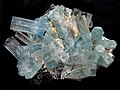 Aquamarine
 -
 Arsenopyrite
 -
 Aurichalcite-Hemimorphite
 -
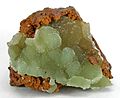 Austinite
 -
 Ametrin from Bolivia
 -
 Barite-Malachite
 -
 Benstonite-Calcite-Fluorite
 -
 Biotite aggregate - Ochtendung, Eifel, Germany
_Can_you_imagine%3F_(5320329773).jpg)
-Stilbite-Ca-118260.jpg)


