Schiøtz tonometer: Difference between revisions
CSV import Tags: mobile edit mobile web edit |
CSV import |
||
| Line 21: | Line 21: | ||
[[Category:Medical equipment]] | [[Category:Medical equipment]] | ||
{{medicine-stub}} | {{medicine-stub}} | ||
<gallery> | |||
File:Schiötz tonometer (close crop) - Skagit County Historical Museum.jpg|Schiøtz tonometer | |||
</gallery> | |||
Latest revision as of 01:44, 20 February 2025
Schiøtz tonometer is a medical instrument used for measuring the intraocular pressure (IOP), which is the fluid pressure inside the eye. It is a type of indentation tonometer that was invented in the early 20th century by the Norwegian ophthalmologist Hjalmar August Schiøtz. This device plays a crucial role in the diagnosis and management of glaucoma, a group of eye conditions that can lead to vision loss by damaging the optic nerve.
History[edit]
The Schiøtz tonometer was introduced in 1905. It was the first practical tool for measuring intraocular pressure and remained the standard instrument for this purpose for many decades. Before its invention, assessing the pressure within the eye was imprecise and relied on subjective methods. The introduction of the Schiøtz tonometer marked a significant advancement in ophthalmology, allowing for more accurate diagnosis and monitoring of conditions like glaucoma.
Design and Function[edit]
The Schiøtz tonometer consists of a footplate that is placed directly on the cornea after applying a numbing agent to the eye to prevent discomfort. Attached to the footplate is a plunger that makes contact with the corneal surface. The weight of the plunger indents the cornea, and the degree of indentation is inversely proportional to the intraocular pressure. The device has a scale that displays the reading of the intraocular pressure based on the indentation.
To achieve accurate measurements, the Schiøtz tonometer comes with different weights that can be added or removed. The choice of weight affects the scale reading, and the correct interpretation of results requires an understanding of the relationship between the weight used and the corresponding scale reading.
Clinical Use[edit]
The Schiøtz tonometer is primarily used in the diagnosis and monitoring of glaucoma. By measuring the intraocular pressure, healthcare providers can assess the risk of damage to the optic nerve, which is a hallmark of glaucoma. Regular monitoring of IOP is essential for patients with glaucoma or those at high risk for the disease, as it helps in adjusting treatment to prevent vision loss.
Limitations[edit]
While the Schiøtz tonometer was a groundbreaking tool, it has several limitations. The accuracy of measurements can be affected by factors such as corneal thickness, rigidity, and the patient's positioning. Modern tonometry methods, such as applanation tonometry and non-contact tonometry, offer more precise measurements and have largely replaced the Schiøtz tonometer in clinical practice. However, the Schiøtz tonometer is still used in some settings, particularly where more advanced equipment is not available.
Conclusion[edit]
The Schiøtz tonometer represents an important milestone in the field of ophthalmology. Despite its limitations and the advent of more advanced tonometry techniques, it laid the foundation for the modern management of glaucoma and other eye conditions related to intraocular pressure. Its invention underscores the importance of accurate diagnostic tools in preserving vision and preventing blindness.

-
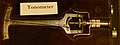 Schiøtz tonometer
_-_Skagit_County_Historical_Museum.jpg)
