Three prime untranslated region: Difference between revisions
CSV import Tags: mobile edit mobile web edit |
CSV import |
||
| Line 27: | Line 27: | ||
{{Genetics-stub}} | {{Genetics-stub}} | ||
<gallery> | |||
File:Central_Dogma_of_Molecular_Biochemistry_with_Enzymes.jpg|Central Dogma of Molecular Biochemistry with Enzymes | |||
File:MRNA_structure.svg|mRNA Structure | |||
File:Stem-loop.svg|Stem-loop Structure | |||
File:Role_of_miRNA_in_a_normal_cell.svg|Role of miRNA in a Normal Cell | |||
File:MRNAcircle.svg|mRNA Circle | |||
File:Alternative_polyadenylation.svg|Alternative Polyadenylation | |||
File:UTR_enfermedades_2_-_multilingual.svg|Three prime untranslated region | |||
</gallery> | |||
Latest revision as of 11:13, 18 February 2025
Three Prime Untranslated Region (3' UTR) refers to the section of messenger RNA (mRNA) that immediately follows the translation termination codon. The 3' UTR itself is not translated into protein, but it plays a crucial role in post-transcriptional regulation of gene expression. This region contains regulatory elements that influence mRNA stability, translation efficiency, and localization, thereby affecting the amount and availability of the corresponding protein.
Function[edit]
The 3' UTR performs several critical functions in cellular biology through its interaction with microRNAs (miRNAs), RNA-binding proteins (RBPs), and other regulatory molecules. These interactions can lead to the suppression or enhancement of gene expression.
MicroRNA Targeting[edit]
One of the primary functions of the 3' UTR is to serve as a binding site for miRNAs. miRNAs are small, non-coding RNAs that regulate gene expression by binding to complementary sequences within the 3' UTR, leading to mRNA degradation or inhibition of translation. This interaction is a key mechanism in the regulation of various biological processes, including development, differentiation, and metabolism.
RNA-Binding Proteins[edit]
RBPs can bind to specific sequences or structures within the 3' UTR, affecting the mRNA's stability and translation. Some RBPs stabilize the mRNA, increasing protein production, while others can lead to mRNA degradation.
Localization Signals[edit]
The 3' UTR can also contain sequences that direct the localization of the mRNA within the cell. This spatial regulation ensures that the protein is synthesized in the vicinity of its site of action, which is crucial for the functioning of highly polarized cells, such as neurons.
Regulation of Gene Expression[edit]
The 3' UTR plays a significant role in the post-transcriptional regulation of gene expression. By influencing mRNA stability and translation efficiency, the 3' UTR can control the levels of protein produced from a given mRNA. This regulation is essential for responding to cellular stress, developmental cues, and other environmental signals.
Diseases and Disorders[edit]
Alterations in the 3' UTR, such as mutations or variations in miRNA binding sites, can lead to dysregulation of gene expression, contributing to the development of diseases, including cancer, neurodegenerative disorders, and heart disease. Understanding the mechanisms of 3' UTR-mediated regulation provides insights into disease pathology and potential therapeutic targets.
Research and Therapeutic Applications[edit]
The study of 3' UTRs and their regulatory roles offers opportunities for the development of novel therapeutic strategies. For example, synthetic miRNAs or miRNA inhibitors can be designed to target specific 3' UTRs, modulating the expression of disease-related genes. Additionally, understanding the mechanisms of 3' UTR regulation can aid in the design of mRNA-based vaccines and therapeutics.

-
 Central Dogma of Molecular Biochemistry with Enzymes
 -
 mRNA Structure
 -
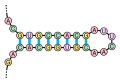 Stem-loop Structure
 -
 Role of miRNA in a Normal Cell
 -
 mRNA Circle
 -
 Alternative Polyadenylation
 -
 Three prime untranslated region


