Wormwood pug: Difference between revisions
CSV import |
CSV import |
||
| Line 33: | Line 33: | ||
[[Category:Geometridae]] | [[Category:Geometridae]] | ||
{{Geometridae-stub}} | {{Geometridae-stub}} | ||
<gallery> | |||
File:Eupithecia_absinthiata.jpg|Eupithecia absinthiata | |||
File:Eupithecia_absinthiata_f._goossensiata.jpg|Eupithecia absinthiata f. goossensiata | |||
File:Eupithecia_absinthiata02.jpg|Eupithecia absinthiata | |||
File:Buckler_W_The_larvæ_of_the_British_butterflies_and_moths_PlateCXXXIV.jpg|Wormwood pug | |||
</gallery> | |||
Latest revision as of 05:01, 18 February 2025
Wormwood Pug (Eupithecia absinthiata) is a species of moth in the family Geometridae. It is widely distributed across Europe and the Palearctic region. The moth is named after its larval food plants, primarily species of wormwood (Artemisia), including the common wormwood (Artemisia absinthium), from which it derives its common and scientific names.
Description[edit]
The Wormwood Pug is a small moth, with a wingspan of 18-23 mm. The forewings are grey or brownish-grey, with distinct black spots and a small, white, central dot. The hindwings are lighter, ranging from white to grey, with faint darker crosslines. The species exhibits some variation in color and pattern, which can make identification challenging.
Life Cycle[edit]
The life cycle of the Wormwood Pug includes several stages: egg, larva (caterpillar), pupa, and adult.
Egg[edit]
The female lays eggs on the underside of the leaves of the host plant. The eggs are oval and light green, becoming darker as they mature.
Larva[edit]
The caterpillar is green with a thin, white line running down the sides of its body. It feeds on the leaves of wormwood and related plants. The larval stage is crucial for growth, and the caterpillar must consume enough food to sustain itself through the non-feeding pupal stage.
Pupa[edit]
After fully maturing, the caterpillar pupates. The pupa is green or brown and is found in a loose cocoon in the soil or among leaf litter.
Adult[edit]
The adult moth emerges from the pupa. Its primary role is reproduction. Adults are nocturnal and are attracted to light.
Habitat[edit]
Wormwood Pug moths are found in a variety of habitats, including gardens, meadows, and open woodland areas, wherever their host plants grow. They prefer habitats with abundant wormwood or other Artemisia species.
Conservation[edit]
The Wormwood Pug is not currently considered threatened. However, like many species, it could be affected by habitat loss and the use of pesticides. Conservation efforts aimed at preserving natural habitats and promoting biodiversity can help ensure the survival of this and other moth species.
See Also[edit]

This article is a geometer moth-related stub. You can help WikiMD by expanding it!
-
 Eupithecia absinthiata
 -
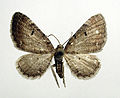 Eupithecia absinthiata f. goossensiata
 -
 Eupithecia absinthiata
 -
 Wormwood pug


