Stramenopile: Difference between revisions
CSV import Tags: mobile edit mobile web edit |
CSV import Tags: mobile edit mobile web edit |
||
| Line 27: | Line 27: | ||
{{Eukaryote-stub}} | {{Eukaryote-stub}} | ||
<gallery> | |||
File:Stramenopiles_diversity.png|Stramenopile | |||
File:Telonema_rivulare_(electron_micrography).jpg|Telonema rivulare (electron micrography) | |||
File:Ammonia_tepida.jpg|Ammonia tepida | |||
File:Cafeteria_roenbergensis_atcc50561_Protsville_(cropped).jpg|Cafeteria roenbergensis | |||
File:Ceratium_furca.jpg|Ceratium furca | |||
File:Aplanonet3.jpg|Aplanonet | |||
File:Cafeteria_roenbergensis_atcc50561_Protsville_(cropped).jpg|Cafeteria roenbergensis | |||
File:Opalina_ranarum_Protsville.jpg|Opalina ranarum | |||
File:Zoospore_release.jpg|Zoospore release | |||
File:Diatoms_through_the_microscope.jpg|Diatoms through the microscope | |||
File:Paraphysomonas_butcheri_whole_mount.jpg|Paraphysomonas butcheri | |||
</gallery> | |||
Latest revision as of 12:21, 18 February 2025
Stramenopiles are a significant group within the Eukaryota that encompasses a diverse array of organisms ranging from algae such as diatoms and brown algae, to the pathogenic oomycetes. This group is characterized by the presence of fine, hair-like projections on their flagella, a feature that is notably absent in many other eukaryotic groups. Stramenopiles play crucial roles in aquatic ecosystems, contributing to the primary production of oxygen and serving as a fundamental part of the food web.
Characteristics[edit]
Stramenopiles are primarily defined by their unique flagellar structure, with one of the two flagella bearing tripartite, tubular hairs. This morphological feature is not only distinctive but also aids in their classification. They exhibit a wide range of life forms, including unicellular and multicellular organisms, and their modes of nutrition can be autotrophic, heterotrophic, or mixotrophic. The cell walls of many stramenopiles, particularly in diatoms, are composed of silica, which contributes to their rigidity and unique fossil record.
Classification[edit]
The classification of stramenopiles has evolved with advances in molecular techniques, particularly phylogenetics. They are part of the larger grouping known as Heterokonta, which includes both photosynthetic and non-photosynthetic members. The major classes within stramenopiles include:
- Phaeophyceae (brown algae) - These are mostly marine, multicellular algae, including many seaweeds such as kelps.
- Bacillariophyceae (diatoms) - Unicellular algae known for their intricate silica cell walls, playing a critical role in global carbon cycling.
- Oomycetes - Often referred to as water molds, they are filamentous organisms that are mostly pathogenic and bear a superficial resemblance to fungi.
- Chrysophyceae (golden algae) and Xanthophyceae (yellow-green algae) - Mostly unicellular algae found in freshwater environments.
Ecological Importance[edit]
Stramenopiles are pivotal in aquatic ecosystems. Diatoms, for instance, are among the most productive photosynthetic organisms on Earth, significantly contributing to the oxygen we breathe and serving as a primary food source for marine and freshwater organisms. Brown algae play a vital role in marine habitats, providing shelter and food for a variety of marine life. On the other hand, oomycetes, while beneficial in breaking down dead material, can also cause devastating diseases in plants, such as the potato blight caused by Phytophthora infestans.
Research and Applications[edit]
Research on stramenopiles spans from understanding their biodiversity and ecological roles to exploring their potential in biotechnology. For example, diatoms are studied for their applications in nanotechnology and biofuel production due to their unique silica cell walls and photosynthetic efficiency. Similarly, the study of oomycetes has significant implications for agriculture and food security, focusing on disease control and resistance.
Conclusion[edit]
Stramenopiles are a diverse and ecologically significant group of eukaryotes that contribute to the functioning of aquatic ecosystems and have potential applications in various scientific fields. Their study not only helps in understanding the complexity of life and evolutionary relationships but also in addressing environmental and agricultural challenges.

-
 Stramenopile
 -
 Telonema rivulare (electron micrography)
 -
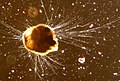 Ammonia tepida
 -
 Cafeteria roenbergensis
 -
 Ceratium furca
 -
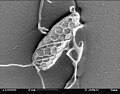 Aplanonet
 -
Cafeteria roenbergensis
-
 Opalina ranarum
 -
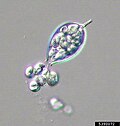 Zoospore release
 -
 Diatoms through the microscope
 -
 Paraphysomonas butcheri

.jpg)

.jpg)


