Stylopharyngeus muscle: Difference between revisions
CSV import Tags: mobile edit mobile web edit |
CSV import |
||
| Line 32: | Line 32: | ||
{{Anatomy-stub}} | {{Anatomy-stub}} | ||
<gallery> | |||
File:Musculusstylopharyngeus.png|Stylopharyngeus muscle | |||
File:Epiglotic_cartilage.jpg|Epiglottic cartilage | |||
File:Gray141.png|Stylopharyngeus muscle | |||
File:Gray950.png|Stylopharyngeus muscle | |||
File:Gray957.png|Stylopharyngeus muscle | |||
File:Gray1019.png|Stylopharyngeus muscle | |||
File:Gray1031.png|Stylopharyngeus muscle | |||
File:Slide9aaa.JPG|Stylopharyngeus muscle | |||
File:Slide16aaa.JPG|Stylopharyngeus muscle | |||
File:Slide3ggg.JPG|Stylopharyngeus muscle | |||
File:Slide8hhh.JPG|Stylopharyngeus muscle | |||
</gallery> | |||
Latest revision as of 10:56, 18 February 2025
Stylopharyngeus Muscle
The Stylopharyngeus muscle is a slender muscle in the human body that plays a crucial role in the process of swallowing. It is part of the pharyngeal muscles group and is involved in elevating the pharynx and larynx. This article provides a comprehensive overview of the anatomy, function, innervation, and clinical significance of the Stylopharyngeus muscle.
Anatomy[edit]
The Stylopharyngeus muscle originates from the styloid process of the temporal bone. It descends downward and medially, between the Superior and Middle pharyngeal constrictor muscles, to insert into the posterior border of the thyroid cartilage and the pharyngeal wall. This muscle is unique because it is the only muscle innervated by the Glossopharyngeal nerve (CN IX).
Function[edit]
The primary function of the Stylopharyngeus muscle is to elevate the pharynx and larynx during swallowing and speaking. By doing so, it helps in the passage of food and liquid from the mouth to the esophagus. It also contributes to the widening of the pharynx which facilitates the passage of a food bolus.
Innervation[edit]
The Stylopharyngeus muscle is innervated by the Glossopharyngeal nerve (CN IX). This nerve provides motor innervation, which enables the muscle to contract and perform its function in the swallowing process.
Clinical Significance[edit]
Dysfunction of the Stylopharyngeus muscle can lead to swallowing difficulties, known medically as Dysphagia. This can result from nerve damage, muscle disorders, or structural abnormalities. Understanding the anatomy and function of the Stylopharyngeus muscle is crucial for diagnosing and treating conditions related to swallowing disorders.
Related Conditions[edit]
- Dysphagia: Difficulty in swallowing.
- Eagle's syndrome: A condition characterized by recurrent pain in the oropharynx and face due to an elongated styloid process or calcified stylohyoid ligament.
- Pharyngitis: Inflammation of the pharynx, which can indirectly affect the function of the Stylopharyngeus muscle.
See Also[edit]
References[edit]
<references/>

-
 Stylopharyngeus muscle
 -
 Epiglottic cartilage
 -
 Stylopharyngeus muscle
 -
 Stylopharyngeus muscle
 -
 Stylopharyngeus muscle
 -
 Stylopharyngeus muscle
 -
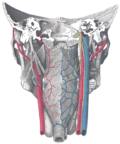 Stylopharyngeus muscle
 -
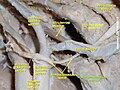 Stylopharyngeus muscle
 -
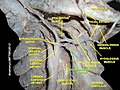 Stylopharyngeus muscle
 -
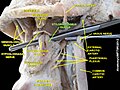 Stylopharyngeus muscle
 -
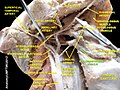 Stylopharyngeus muscle


