Local area network: Difference between revisions
CSV import |
CSV import Tags: mobile edit mobile web edit |
||
| Line 42: | Line 42: | ||
{{Networking-stub}} | {{Networking-stub}} | ||
<gallery> | |||
File:Home_LAN_local_area_network_example_diagram.png|Home LAN local area network example diagram | |||
File:RJ-45-Stecker-und-Buechse.jpg|RJ-45 connector and socket | |||
File:Simple_LAN_example_diagram_in_two_rooms.png|Simple LAN example diagram in two rooms | |||
File:LAN_topology.gif|LAN topology | |||
</gallery> | |||
Latest revision as of 05:03, 18 February 2025
Local Area Network (LAN) is a computer network that interconnects computers within a limited area such as a residence, school, laboratory, university campus, or office building. By design, LANs offer high data transfer rates and typically connect personal computers, workstations, and other devices such as printers and storage devices. LANs allow users to share resources and communicate efficiently within a small geographic area. The defining characteristics of LANs, in contrast to wide area networks (WANs), include their smaller geographic area and non-reliance on leased telecommunication lines.
Overview[edit]
LANs are composed of interconnected computers and peripheral devices that are capable of sharing resources and information. The connections between devices in a LAN are made using either wired media, such as Ethernet cables, or wireless media, such as Wi-Fi. A LAN is controlled by a network operating system and utilizes networking hardware like switches, routers, and network interface cards.
History[edit]
The concept of a LAN has evolved significantly since its inception in the 1970s. Initially, LANs were used primarily in academic and research settings. The development of Ethernet in the 1970s and the subsequent introduction of the IEEE 802.3 standard in the 1980s played a crucial role in the widespread adoption of LANs in both business and personal contexts.
Technology[edit]
Ethernet[edit]
Ethernet is the most widely used LAN technology. It defines wiring and signaling standards for the physical layer of the TCP/IP model, as well as a common addressing format and media access control at the data link layer.
Wi-Fi[edit]
Wi-Fi is a wireless networking technology that allows devices to communicate without direct cable connections. It's a popular choice for wireless LANs and is based on the IEEE 802.11 family of standards.
Network Devices[edit]
Switches[edit]
Switches are networking devices that connect devices on a LAN and use packet switching to forward data to its destination.
Routers[edit]
Routers are used to connect multiple LANs and to connect LANs to wider networks like the internet. They route packets of data between networks based on their IP addresses.
Network Interface Cards (NICs)[edit]
NICs are hardware components that connect a computer or other device to a network. They can be wired or wireless.
Applications[edit]
LANs are used in a variety of settings, including homes, offices, schools, and industrial facilities, for:
- File sharing
- Printer access
- Internet access
- Gaming
Security[edit]
Security in LANs involves both physical and software measures to protect data and restrict unauthorized access. Common security practices include the use of firewalls, antivirus software, and network encryption.
Future of LANs[edit]
The future of LANs involves the integration of more wireless technologies, increased data transfer speeds, and greater connectivity with IoT (Internet of Things) devices. Developments in technologies such as Wi-Fi 6 and beyond are expected to further enhance the performance and reliability of wireless LANs.

This article is a computer networking stub. You can help WikiMD by expanding it!
-
 Home LAN local area network example diagram
 -
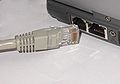 RJ-45 connector and socket
 -
 Simple LAN example diagram in two rooms
 -
 LAN topology


