QPNC-PAGE: Difference between revisions
CSV import |
CSV import |
||
| Line 43: | Line 43: | ||
{{Molecular-biology-stub}} | {{Molecular-biology-stub}} | ||
{{Analytical-chemistry-stub}} | {{Analytical-chemistry-stub}} | ||
== QPNC-PAGE == | |||
<gallery> | |||
File:Folding funnel schematic.svg|Folding funnel schematic | |||
File:Electrphoresis Tools.TIF|Electrophoresis Tools | |||
File:Preparative Electroph.TIF|Preparative Electrophoresis | |||
</gallery> | |||
Latest revision as of 01:06, 20 February 2025
QPNC-PAGE (Quantitative Preparative Native Continuous Polyacrylamide Gel Electrophoresis) is a specialized laboratory technique used in biochemistry, molecular biology, and analytical chemistry to separate proteins based on their electrophoretic mobility under native, non-denaturing conditions. This method is particularly useful for the isolation, purification, and quantification of proteins and protein complexes, maintaining their native enzyme activities and protein-protein interactions.
Overview[edit]
QPNC-PAGE is an advanced form of Polyacrylamide gel electrophoresis (PAGE) that allows for the separation of proteins without the use of denaturing agents such as sodium dodecyl sulfate (SDS). Unlike SDS-PAGE, which separates proteins based on their molecular weight, QPNC-PAGE separates proteins based on their native shape and charge. This technique is invaluable for studying protein complexes in their native state, analyzing subunit compositions, and for applications requiring the recovery of functional proteins.
Principle[edit]
The principle behind QPNC-PAGE involves the application of an electric field to a polyacrylamide gel matrix through which proteins can migrate. Proteins are charged molecules, and their rate of migration through the gel is influenced by their size, shape, and charge. In QPNC-PAGE, proteins are not coated with SDS; therefore, they maintain their native conformation and charge properties. The migration of proteins in the gel allows for their separation based on these native characteristics.
Procedure[edit]
The QPNC-PAGE procedure begins with the preparation of a polyacrylamide gel. Proteins are then loaded into the gel without being denatured by heat or detergents. An electric current is applied, causing proteins to migrate through the gel matrix. Smaller or more negatively charged proteins will migrate faster, while larger or less charged proteins will migrate more slowly. After electrophoresis, the proteins can be visualized using various staining methods, depending on the specific application and sensitivity required.
Applications[edit]
QPNC-PAGE is used in a wide range of applications, including:
- Isolation and purification of intact protein complexes for further analysis.
- Study of enzyme activities in their native conformation.
- Analysis of protein-protein interactions.
- Preparation of samples for mass spectrometry without the need for denaturing.
- Comparative studies of protein isoforms and post-translational modifications.
Advantages[edit]
- Maintains the native state of proteins, allowing for the study of functional activities.
- Enables the separation of protein complexes without dissociation.
- Suitable for quantitative analysis.
Limitations[edit]
- May not fully resolve proteins with similar sizes and charges.
- Requires optimization for specific proteins or complexes.
- Less common than SDS-PAGE, leading to a smaller body of comparative data.
See Also[edit]
- Polyacrylamide gel electrophoresis
- SDS-PAGE
- Western blot
- Mass spectrometry
- Protein-protein interactions
.svg)
This article is a biochemistry stub. You can help WikiMD by expanding it!

This article is a molecular biology stub. You can help WikiMD by expanding it!

QPNC-PAGE[edit]
-
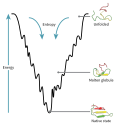 Folding funnel schematic
 -
 Electrophoresis Tools
 -
 Preparative Electrophoresis

