Protein purification: Difference between revisions
CSV import |
CSV import |
||
| Line 35: | Line 35: | ||
{{Biotechnology-stub}} | {{Biotechnology-stub}} | ||
{{Molecular-biology-stub}} | {{Molecular-biology-stub}} | ||
== Protein_purification == | |||
<gallery> | |||
File:Shakeflask.JPG|Shake flask used in protein purification | |||
File:Size_exclusion.jpg|Size exclusion chromatography column | |||
File:Metal-affinity_column.jpg|Metal-affinity chromatography column | |||
File:Hplc.JPG|High-performance liquid chromatography (HPLC) setup | |||
File:Ultra_filtration.JPG|Ultrafiltration apparatus for protein purification | |||
</gallery> | |||
Latest revision as of 05:03, 18 February 2025
Protein purification is a series of processes intended to isolate a single type of protein from a complex mixture. This is vital for the characterization of the function, structure, and interactions of the protein of interest. The process of protein purification must be carefully designed to maintain the integrity of the protein and ensure that it remains functional.
Overview[edit]
Protein purification is essential in biotechnology, molecular biology, and biochemistry. The process involves separating proteins from various cellular components or other proteins with which they may be associated. The complexity of the purification process depends on the nature of the protein, its source, and its intended use. For example, therapeutic proteins require extremely high levels of purity and are subject to rigorous regulatory standards.
Techniques[edit]
Several techniques are employed in the purification process, each suited to specific types of proteins and the scale of the operation. These include:
- Chromatography: A technique that separates proteins based on differences in their physical and chemical properties. Types of chromatography used in protein purification include ion exchange, affinity, and size exclusion chromatography.
- Electrophoresis: A method that involves the movement of charged protein molecules through a gel under the influence of an electric field. SDS-PAGE is a common type of electrophoresis used for protein purification.
- Centrifugation: This technique separates proteins based on their size and density by spinning them at high speeds. Differential centrifugation and ultracentrifugation are two types commonly used.
- Precipitation: The process of precipitating a protein by altering its solubility through the addition of salts or solvents.
- Filtration: A method that separates proteins based on size using a membrane filter.
Applications[edit]
Protein purification is crucial in various applications, including:
- Research and development in the life sciences, where purified proteins are required for studying their structure, function, and interactions.
- The production of biopharmaceuticals, where proteins such as antibodies or hormones are purified for therapeutic use.
- The manufacturing of industrial enzymes used in food processing, biofuel production, and other applications.
Challenges[edit]
Despite advances in technology, protein purification can still present challenges, such as:
- Maintaining the activity and stability of the protein throughout the purification process.
- Scaling up the purification process from laboratory to industrial scale without compromising purity or yield.
- The high cost of purification, especially for proteins requiring high purity levels.
Conclusion[edit]
Protein purification is a critical step in the study and application of proteins in various fields. Advances in purification techniques continue to improve the efficiency and effectiveness of this process, enabling the production of high-purity proteins for research, therapeutic, and industrial applications.
.svg)
This article is a biochemistry stub. You can help WikiMD by expanding it!
This article is a Biotechnology stub. You can help WikiMD by expanding it!

This article is a molecular biology stub. You can help WikiMD by expanding it!
Protein_purification[edit]
-
 Shake flask used in protein purification
 -
 Size exclusion chromatography column
 -
 Metal-affinity chromatography column
 -
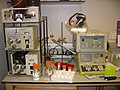 High-performance liquid chromatography (HPLC) setup
 -
 Ultrafiltration apparatus for protein purification


