Deubiquitinating enzyme: Difference between revisions
CSV import |
CSV import |
||
| Line 30: | Line 30: | ||
[[Category:Cell biology]] | [[Category:Cell biology]] | ||
{{medicine-stub}} | {{medicine-stub}} | ||
<gallery> | |||
File:Ubiquitin_and_USP21.png|Ubiquitin and USP21 | |||
File:Ub_AMC.jpeg|Ub AMC | |||
File:PDB_2hd5_EBI.jpg|PDB 2hd5 EBI | |||
File:DUBs.png|DUBs | |||
File:Catalytic_domain_of_USP7.png|Catalytic domain of USP7 | |||
File:PDB_1w6v_EBI.jpg|PDB 1w6v EBI | |||
File:DUBs_in_the_cell_cycle.png|DUBs in the cell cycle | |||
File:Role_of_USP7_in_p53-dependent_path.png|Role of USP7 in p53-dependent path | |||
</gallery> | |||
Latest revision as of 11:19, 18 February 2025
Deubiquitinating enzymes (DUBs) are a group of proteases that processively cleave ubiquitin from proteins. Ubiquitin is a small regulatory protein that is attached to substrates, usually to signal their degradation via the proteasome, alter their cellular location, affect their activity, or promote or prevent protein interactions. DUBs reverse this modification, which can have profound effects on many cellular processes, including cell cycle control, DNA repair, transcription, and signal transduction. DUBs are thus crucial for maintaining cellular homeostasis and their dysregulation is associated with various diseases, including cancer, neurodegeneration, and infections.
Function[edit]
DUBs are involved in the editing and remodeling of the ubiquitin landscape on substrates, thereby regulating the fate and function of these proteins. They are essential for the recycling of ubiquitin, rescuing it from degradation with the substrate proteins, and thus maintaining the cellular pool of free ubiquitin. This is critical in cells where ubiquitin is limited and must be reused. DUBs also play a key role in the removal of ubiquitin from substrates that have been mis-targeted for degradation, thus acting as a quality control mechanism.
Classification[edit]
DUBs are classified into several families based on their catalytic mechanisms and sequence similarities. The main families include:
- Ubiquitin-specific proteases (USPs)
- Ubiquitin C-terminal hydrolases (UCHs)
- Ovarian tumor proteases (OTUs)
- Machado-Joseph disease protein domain proteases (MJDs)
- JAB1/MPN/MOV34 metalloenzymes (JAMMs)
Each family has distinct substrate specificities, mechanisms of action, and cellular functions.
Role in Disease[edit]
The dysregulation of DUB activity can lead to the stabilization of oncoproteins, degradation of tumor suppressor proteins, and interference with cell death mechanisms, contributing to the development and progression of cancer. In neurodegenerative diseases, such as Parkinson's disease and Alzheimer's disease, the accumulation of ubiquitinated proteins due to defective DUB activity is a common pathological feature. Furthermore, certain viruses encode DUBs to manipulate the host cell's ubiquitin system to promote viral replication and evade the immune response.
Therapeutic Potential[edit]
Given their central role in various cellular processes and disease states, DUBs have emerged as potential therapeutic targets. Inhibitors of specific DUBs are being developed as drugs for the treatment of cancer, neurodegenerative diseases, and infections. However, the challenge lies in achieving specificity, as inhibiting a DUB involved in multiple cellular processes could have widespread effects.
Research Tools[edit]
To study DUBs, researchers use various biochemical and genetic tools. Ubiquitin-based probes that can bind specifically to DUBs, allowing for their purification and study, are commonly used. Additionally, genetic techniques such as RNA interference (RNAi) and CRISPR/Cas9 are employed to knock down or knockout DUBs, respectively, to study their function and involvement in disease.
Conclusion[edit]
Deubiquitinating enzymes play a critical role in the regulation of protein ubiquitination, impacting numerous cellular processes and disease states. Their study offers insights into the fundamental mechanisms of cell regulation and provides opportunities for the development of novel therapeutic strategies.

-
 Ubiquitin and USP21
 -
 Ub AMC
 -
 PDB 2hd5 EBI
 -
 DUBs
DUBs -
 Catalytic domain of USP7
 -
 PDB 1w6v EBI
 -
 DUBs in the cell cycle
 -
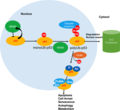 Role of USP7 in p53-dependent path


