Schizosaccharomyces pombe: Difference between revisions
CSV import Tags: mobile edit mobile web edit |
CSV import |
||
| Line 30: | Line 30: | ||
{{Mya-stub}} | {{Mya-stub}} | ||
{{Genetics-stub}} | {{Genetics-stub}} | ||
== Schizosaccharomyces pombe gallery == | |||
<gallery> | |||
File:fission yeast.jpg|Fission yeast | |||
File:Schizosaccharomyces pombe tsentrosoom.jpg|Schizosaccharomyces pombe tsentrosoom | |||
File:Fission yeast division.jpg|Fission yeast division | |||
File:general cell cycle.jpg|General cell cycle | |||
File:fission yeast cell cycle structure.jpg|Fission yeast cell cycle structure | |||
File:Schizosaccharomyces pombe division.JPG|Schizosaccharomyces pombe division | |||
File:fission yeast cytokinesis.jpg|Fission yeast cytokinesis | |||
File:fission yeast cell size.jpg|Fission yeast cell size | |||
</gallery> | |||
Latest revision as of 06:17, 3 March 2025
Schizosaccharomyces pombe, commonly known as "fission yeast," is a species of yeast that has become a pivotal model organism in molecular and cellular biology. Unlike the more commonly known Saccharomyces cerevisiae (baker's yeast), which divides by budding, Schizosaccharomyces pombe divides by binary fission, a process similar to that of bacterial cell division. This characteristic, among others, makes it an invaluable tool for studying the cell cycle, cell morphology, and genetics.
Characteristics[edit]
Schizosaccharomyces pombe is a unicellular eukaryote with a rod-shaped appearance, typically measuring 3-4 µm in width and 7-14 µm in length. Its genome is organized into three chromosomes, totaling approximately 14 million base pairs, and it has been fully sequenced, providing a comprehensive resource for genetic studies. The organism thrives in sugary environments and is naturally found in the nectar of tropical fruits as well as in fermenting fruit juices.
Genetics and Cell Cycle[edit]
The simplicity of the Schizosaccharomyces pombe cell cycle has made it a prime subject for genetic and cell biology research. It undergoes a well-defined cell cycle consisting of four phases: G1 (gap 1), S (synthesis), G2 (gap 2), and M (mitosis). Researchers have identified numerous genes involved in cell cycle regulation, many of which have homologs in more complex eukaryotes, including humans. This has allowed for the extrapolation of findings in S. pombe to understand the cell cycle mechanisms in multicellular organisms.
Research Applications[edit]
Schizosaccharomyces pombe has been used in a wide range of biological research areas beyond cell cycle studies. These include:
- **DNA Repair and Genomic Stability**: Studies in S. pombe have contributed significantly to our understanding of the mechanisms underlying DNA repair and the maintenance of genomic integrity. - **Epigenetics**: The yeast has been a model for investigating chromatin structure and function, including the role of histone modifications and DNA methylation in gene expression regulation. - **Signal Transduction**: S. pombe is used to study the pathways cells use to sense and respond to their environment, including stress responses and pheromone signaling.
Laboratory Cultivation[edit]
Cultivating Schizosaccharomyces pombe in the laboratory is straightforward, requiring minimalistic nutrient media, such as yeast extract with supplements (YES) or Edinburgh Minimal Medium (EMM). It grows optimally at temperatures around 30°C, with a doubling time of approximately 2-3 hours under ideal conditions.
Comparison with Saccharomyces cerevisiae[edit]
While both S. pombe and S. cerevisiae are yeasts used extensively in research, they differ significantly in their biology and utility as model organisms. S. cerevisiae is often preferred for studies on gene expression and protein function, given its well-characterized genetics and the ease of genetic manipulation. In contrast, S. pombe offers advantages for cell cycle and cell morphology studies due to its simpler cell cycle and division by binary fission.
Conclusion[edit]
Schizosaccharomyces pombe continues to be a vital model organism in the field of molecular and cellular biology. Its unique characteristics and the wealth of genetic tools available make it an indispensable resource for understanding fundamental biological processes.

Schizosaccharomyces pombe gallery[edit]
-
 Fission yeast
 -
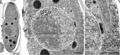 Schizosaccharomyces pombe tsentrosoom
 -
 Fission yeast division
 -
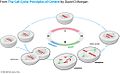 General cell cycle
 -
 Fission yeast cell cycle structure
 -
 Schizosaccharomyces pombe division
 -
 Fission yeast cytokinesis
 -
 Fission yeast cell size


