Phosphorus pentoxide: Difference between revisions
CSV import |
CSV import |
||
| Line 33: | Line 33: | ||
{{Chem-stub}} | {{Chem-stub}} | ||
<gallery> | |||
File:Sample_of_Phosphorus_pentoxide.jpg|Sample of Phosphorus pentoxide | |||
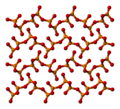
File:Phosphorus-pentoxide-sheet-from-xtal-3D-balls.png|Phosphorus pentoxide sheet from crystal 3D balls | |||
File:Phosphorus-pentoxide-xtal-3D-balls.png|Phosphorus pentoxide crystal 3D balls | |||
File:Structures_of_phosphorus_oxides_edit.png|Structures of phosphorus oxides | |||
</gallery> | |||
Latest revision as of 05:04, 18 February 2025
Phosphorus pentoxide is a chemical compound with the molecular formula P4O10. This white crystalline solid is the anhydride of phosphoric acid. It is a powerful desiccant and dehydrating agent.
Properties[edit]
Phosphorus pentoxide exists in several polymorphic forms. The most common form is a white powder. It is highly hygroscopic and can absorb moisture from the air, which makes it a useful desiccant. Phosphorus pentoxide reacts with water to form phosphoric acid, according to the chemical equation:
P4O10 + 6H2O → 4H3PO4
This reaction is highly exothermic.
Production[edit]
Phosphorus pentoxide is produced by the combustion of elemental phosphorus in the presence of excess oxygen. The reaction can be represented by the equation:
4P + 5O2 → P4O10
Uses[edit]
Due to its strong affinity for water, phosphorus pentoxide is used as a dehydrating agent in organic synthesis. It is particularly useful in converting amides to nitriles, and in the preparation of anhydrides from carboxylic acids. In the electronics industry, it is used as a drying agent for gases and in the manufacture of optical glass.
Safety[edit]
Phosphorus pentoxide is a potent irritant and can cause severe burns upon contact with skin or mucous membranes. It should be handled with extreme care, with appropriate personal protective equipment. In case of exposure, immediate steps should be taken to wash the affected area with plenty of water.
Environmental Impact[edit]
The production and use of phosphorus pentoxide must be carefully managed to minimize environmental impact. Its reaction with water can lead to the release of phosphoric acid, which can contribute to water pollution if not properly contained.
See Also[edit]

-
 Sample of Phosphorus pentoxide
 -
 Phosphorus pentoxide sheet from crystal 3D balls
 -
 Phosphorus pentoxide crystal 3D balls
 -
 Structures of phosphorus oxides


