Purine nucleoside phosphorylase: Difference between revisions
CSV import |
CSV import |
||
| Line 27: | Line 27: | ||
{{Medicine-stub}} | {{Medicine-stub}} | ||
<gallery> | |||
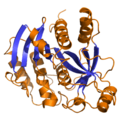
File:1rct.png|Purine_nucleoside_phosphorylase | |||
File:Purine-nucleoside_phosphate_ribosyltransferase.png|Purine_nucleoside_phosphorylase | |||
</gallery> | |||
Latest revision as of 01:11, 18 February 2025
Purine nucleoside phosphorylase (PNP) is an enzyme that plays a crucial role in the metabolism of nucleotides, specifically in the purine degradation pathway. It catalyzes the reversible phosphorolysis of purine nucleosides to produce purine bases and ribose 1-phosphate. This enzyme is essential for the salvage of purines and for the regulation of purine nucleotide concentrations within the cell.
Function[edit]
PNP is involved in the purine salvage pathway, which recycles purines from degraded nucleic acids for the synthesis of new nucleotides. The enzyme specifically catalyzes the cleavage of the glycosidic bond between the ribose sugar and the purine base in nucleosides. This reaction results in the formation of free purine bases, such as adenine, guanine, and hypoxanthine, which can then be reused by the cell to synthesize new nucleotides. The other product of this reaction, ribose 1-phosphate, can be converted into ribose 5-phosphate by phosphoribomutase and then into 5-phosphoribosyl 1-pyrophosphate (PRPP), a precursor for the synthesis of nucleotides.
Clinical Significance[edit]
Mutations in the gene encoding PNP can lead to a rare, autosomal recessive metabolic disorder known as Purine nucleoside phosphorylase deficiency. This condition results in the accumulation of deoxyguanosine triphosphate (dGTP), which is toxic to lymphocytes, leading to immunodeficiency with severe combined immunodeficiency (SCID). Patients with PNP deficiency exhibit a profound susceptibility to viral, bacterial, and fungal infections due to the impaired function of T cells and, to a lesser extent, B cells.
Structure[edit]
PNP is a homotrimer, meaning it is composed of three identical subunits. Each subunit contains a phosphate binding site and a purine base binding site, facilitating the enzyme's catalytic activity. The structure of PNP has been elucidated through X-ray crystallography, revealing insights into its mechanism of action and allowing for the design of specific inhibitors that can modulate its activity for therapeutic purposes.
Inhibitors[edit]
Inhibitors of PNP have been explored as potential therapeutic agents for various conditions, including autoimmune diseases and cancer. By inhibiting PNP, the salvage pathway for purines is disrupted, leading to a decrease in purine nucleotide synthesis. This can have a cytotoxic effect on rapidly dividing cells, such as those found in tumors, making PNP inhibitors a target for anticancer drugs. Additionally, because PNP activity is crucial for the proliferation of T and B cells, its inhibitors have been investigated for the treatment of autoimmune diseases.
See Also[edit]
References[edit]
<references/>

-
 Purine_nucleoside_phosphorylase
 -
 Purine_nucleoside_phosphorylase


