Ring-imaging Cherenkov detector: Difference between revisions
CSV import Tags: mobile edit mobile web edit |
CSV import |
||
| Line 37: | Line 37: | ||
[[Category:Experimental particle physics]] | [[Category:Experimental particle physics]] | ||
{{physics-stub}} | {{physics-stub}} | ||
<gallery> | |||
File:Cherenlov angle plot.jpg|Cherenlov angle plot | |||
File:Polar plot of Chrenkov photons emission angles.jpg|Polar plot of Chrenkov photons emission angles | |||
File:Mean Cherenkov angle vs momentum2.jpg|Mean Cherenkov angle vs momentum | |||
File:Pion-kaon separation Nsigma.jpg|Pion-kaon separation Nsigma | |||
File:Kaon identification plot.jpg|Kaon identification plot | |||
File:LHCb RICH Btoππ.jpg|LHCb RICH B to ππ | |||
File:RICH two types02 2013-03-15.svg|RICH two types | |||
File:DIRC Schema01 2013-03-15.svg|DIRC Schema | |||
File:Lhcbview.jpg|LHCb view | |||
File:Alpha Magnetic Spectrometer - 02.jpg|Alpha Magnetic Spectrometer | |||
</gallery> | |||
Latest revision as of 05:13, 3 March 2025
Ring-Imaging Cherenkov (RICH) detector is a type of particle detector that utilizes the Cherenkov radiation phenomenon to identify the velocity and the type of charged particles. This detector is particularly useful in high-energy physics experiments and astrophysics observations for particle identification over a wide range of momenta.
Principle[edit]
The principle of operation of a RICH detector is based on the Cherenkov effect, which occurs when a charged particle moves through a medium at a speed greater than the speed of light in that medium. This results in the emission of Cherenkov radiation, which forms a cone of light with an opening angle that depends on the velocity of the particle. By measuring the angle of this cone, the velocity of the particle can be determined. When combined with information on the particle's momentum, obtained from other detectors, the particle's mass, and hence its identity, can be inferred.
Components[edit]
A typical RICH detector consists of three main components:
- A radiator medium, through which the charged particles pass and emit Cherenkov radiation. The choice of radiator is crucial and depends on the desired momentum range for particle identification. Gases, liquids, and solids can all serve as radiators.
- A photodetector array, positioned to capture the Cherenkov photons. The design of the photodetector must balance factors such as efficiency, resolution, and coverage area.
- An optical system that focuses the Cherenkov photons onto the photodetector. This system may include lenses, mirrors, or a combination of both, designed to accurately image the Cherenkov ring onto the photodetector.
Applications[edit]
RICH detectors are employed in a variety of research areas including:
- High-energy physics experiments, such as those conducted at the Large Hadron Collider (LHC), for particle identification.
- Astrophysics and cosmic ray studies, for identifying the composition of primary cosmic rays.
- Nuclear physics, for studying the structure and reactions of nuclei.
Advantages[edit]
The main advantages of RICH detectors include:
- High precision in measuring the velocity of charged particles.
- The ability to identify particles over a wide range of momenta.
- Versatility in being adapted for different experimental requirements by changing the radiator medium or the geometry of the detector.
Challenges[edit]
Despite their advantages, RICH detectors also face several challenges:
- The complexity of the optical system and the need for precise alignment.
- The requirement for high-efficiency, low-noise photodetectors.
- The need to integrate with other types of detectors in complex experimental setups.
Future Developments[edit]
Ongoing research and development efforts aim to improve RICH detectors by:
- Enhancing the resolution and efficiency of photodetectors.
- Exploring new radiator materials to extend the momentum range for particle identification.
- Developing advanced algorithms for more accurate reconstruction of particle identities.

-
 Cherenlov angle plot
 -
 Polar plot of Chrenkov photons emission angles
 -
 Mean Cherenkov angle vs momentum
 -
 Pion-kaon separation Nsigma
 -
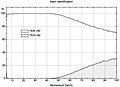 Kaon identification plot
 -
 LHCb RICH B to ππ
 -
 RICH two types
 -
 DIRC Schema
 -
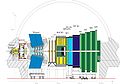 LHCb view
 -
 Alpha Magnetic Spectrometer


