Wittig reaction: Difference between revisions
CSV import Tags: mobile edit mobile web edit |
CSV import |
||
| Line 23: | Line 23: | ||
{{Chemistry-stub}} | {{Chemistry-stub}} | ||
== Wittig_reaction == | |||
<gallery> | |||
File:Wittig_Reaktion.svg|Wittig reaction | |||
File:Wittig_reaction_mechanism.svg|Wittig reaction mechanism | |||
File:Schlosser_Wittig.svg|Schlosser modification of the Wittig reaction | |||
File:Corey_Schlosser_Wittig.png|Corey-Schlosser modification of the Wittig reaction | |||
File:Leukotriene_A_synthesis.svg|Leukotriene A synthesis using the Wittig reaction | |||
</gallery> | |||
Latest revision as of 04:51, 18 February 2025
Wittig Reaction
The Wittig Reaction is a widely used chemical reaction that involves the synthesis of alkenes (olefins) from phosphonium ylides and aldehydes or ketones. It was discovered by German chemist Georg Wittig, for which he was awarded the Nobel Prize in Chemistry in 1979. This reaction is of significant importance in the field of organic chemistry, particularly in the synthesis of complex molecules in the pharmaceutical industry, agrochemical production, and the synthesis of natural products and fine chemicals.
Mechanism[edit]
The Wittig reaction mechanism is characterized by a few key steps. Initially, a phosphonium ylide is generated by deprotonation of a phosphonium salt, which is then reacted with an aldehyde or ketone to form a betaine intermediate. This intermediate undergoes a chemical reaction known as a pericyclic process, leading to the formation of an oxaphosphetane. The oxaphosphetane eventually collapses, giving rise to the desired alkene and a phosphine oxide by-product.
Applications[edit]
The Wittig reaction has found extensive applications in organic synthesis. It is particularly useful for the synthesis of stereodefined alkenes due to its ability to form both E and Z isomers. This has made it a valuable tool in the synthesis of vitamins, pharmaceuticals, and pheromones. Additionally, it has been employed in the synthesis of complex natural products and in the modification of steroids.
Variants[edit]
Several variants of the Wittig reaction exist, including the Schlosser modification, which allows for the generation of highly reactive ylides that can react with less reactive ketones. The Horner-Wadsworth-Emmons (HWE) reaction is another important variant, which uses phosphonate esters instead of phosphonium salts, leading to the formation of more stable and readily available reagents.
Limitations[edit]
Despite its widespread use, the Wittig reaction has some limitations. The reaction conditions can sometimes lead to isomerization of the product alkene, and the phosphine oxide by-product can be difficult to separate from the reaction mixture. Additionally, the reaction typically requires strong bases, which can be incompatible with sensitive functional groups.
Conclusion[edit]
The Wittig reaction remains a cornerstone of organic synthesis, offering a versatile and efficient method for the construction of carbon-carbon double bonds. Its impact on the synthesis of complex organic molecules cannot be overstated, making it a fundamental tool in the arsenal of organic chemists.

Wittig_reaction[edit]
-
 Wittig reaction
 -
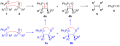 Wittig reaction mechanism
 -
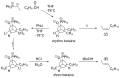 Schlosser modification of the Wittig reaction
 -
 Corey-Schlosser modification of the Wittig reaction
 -
 Leukotriene A synthesis using the Wittig reaction


