Phthalocyanine: Difference between revisions
CSV import |
CSV import |
||
| Line 37: | Line 37: | ||
[[Category:Coordination chemistry]] | [[Category:Coordination chemistry]] | ||
{{Chemistry-stub}} | {{Chemistry-stub}} | ||
<gallery> | |||
File:Phthalocyanine.svg|Phthalocyanine structure | |||
File:Phthalocyanine-3D-balls.png|3D model of Phthalocyanine | |||
File:Phthalocyanine_STM.jpg|Scanning Tunneling Microscope image of Phthalocyanine | |||
File:Copper_phthalocyanine.svg|Copper Phthalocyanine structure | |||
File:Phthalocyanine_Green_G.png|Phthalocyanine Green G | |||
File:Copper_Phtalocyanine_Blue.JPG|Copper Phthalocyanine Blue | |||
File:relpor.png|Phthalocyanine | |||
</gallery> | |||
Latest revision as of 11:08, 18 February 2025
Phthalocyanine is a large, aromatic, macrocyclic compound that is of significant interest in various fields such as organic chemistry, materials science, and dye chemistry. It is structurally related to the naturally occurring porphyrin pigments, which are vital to many biological processes. Phthalocyanines are particularly noted for their intense blue or green colors, high stability, and ability to form coordination complexes with a wide range of metals. These properties make them useful in a variety of applications, including as dyes and pigments, in photovoltaic cells, and as catalysts in chemical reactions.
Structure and Properties[edit]
The basic structure of a phthalocyanine molecule consists of four isoindole units linked by nitrogen atoms to form a large, planar, 18-membered ring. This ring system can coordinate to a metal atom at its center, forming a metallophthalocyanine. The metal can significantly influence the properties of the phthalocyanine, including its color, solubility, and reactivity. Common metals that form phthalocyanine complexes include copper, zinc, cobalt, and iron.
Phthalocyanines are characterized by their intense blue or green coloration, which is due to their strong absorption of light in the red and near-infrared regions of the spectrum. They are also highly stable to heat, light, and chemical attack, making them suitable for use in harsh environments.
Synthesis[edit]
Phthalocyanines can be synthesized through the cyclotetramerization of phthalonitrile, either in the presence or absence of a metal salt. This reaction typically requires high temperatures and a catalyst. The choice of solvent, temperature, and metal salt can influence the yield and properties of the resulting phthalocyanine.
Applications[edit]
Due to their unique properties, phthalocyanines find use in a wide range of applications:
Dyes and Pigments[edit]
Phthalocyanines are used extensively as dyes and pigments in inks, paints, and plastics. They provide vibrant colors that are resistant to fading under light and heat exposure.
Organic Photovoltaics[edit]
In the field of organic photovoltaics, phthalocyanines are used as electron-donating materials due to their strong light absorption and ability to transport charge.
Catalysis[edit]
Metallophthalocyanines are used as catalysts in various chemical reactions, including the oxidation of organic compounds and the reduction of nitrogen oxides in exhaust gases.
Sensors[edit]
Phthalocyanines are also employed in the development of chemical sensors due to their ability to undergo reversible changes in electrical conductivity upon exposure to certain substances.
Health and Safety[edit]
While phthalocyanines are generally considered to be of low toxicity, their safety can depend on the specific compound and its application. It is always important to handle chemical substances with appropriate safety precautions.
See Also[edit]

-
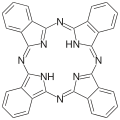 Phthalocyanine structure
 -
3D model of Phthalocyanine
-
Scanning Tunneling Microscope image of Phthalocyanine
-
Copper Phthalocyanine structure
-
Phthalocyanine Green G
-
Copper Phthalocyanine Blue
-
Phthalocyanine


