Ultraviolet germicidal irradiation: Difference between revisions
CSV import Tags: mobile edit mobile web edit |
CSV import |
||
| (One intermediate revision by the same user not shown) | |||
| Line 1: | Line 1: | ||
{{short description|Use of ultraviolet light to kill or inactivate microorganisms}} | |||
{{Use dmy dates|date=October 2023}} | |||
== | '''Ultraviolet germicidal irradiation''' ('''UVGI''') is a disinfection method that uses short-wavelength ultraviolet (UV-C) light to kill or inactivate microorganisms by destroying nucleic acids and disrupting their DNA, leaving them unable to perform vital cellular functions. UVGI is used in a variety of applications, such as food, air, and water purification. | ||
UVGI utilizes [[ | |||
==Mechanism of action== | |||
UVGI utilizes [[ultraviolet]] light in the UV-C range, typically between 200 and 280 nanometers. This range is effective in breaking down the DNA of microorganisms, rendering them harmless. The effectiveness of UVGI depends on the intensity and duration of exposure, as well as the wavelength of the UV light. | |||
==Applications== | ==Applications== | ||
=== | ===Air disinfection=== | ||
UVGI is used in [[HVAC]] systems to disinfect air. It is particularly useful in healthcare settings to reduce the spread of airborne pathogens. UV lamps are installed in the ducts or mounted in the upper room of a space to continuously disinfect the air as it circulates. | |||
=== | ===Water disinfection=== | ||
UVGI | UVGI is widely used in water treatment facilities to disinfect drinking water. It is effective against a wide range of pathogens, including bacteria, viruses, and protozoa. UV water purification systems are also available for home use. | ||
== | ===Surface disinfection=== | ||
UVGI can be used to disinfect surfaces in laboratories, hospitals, and other settings where sterilization is critical. Portable UV devices are available for disinfecting surfaces in homes and offices. | |||
== | ===Food and beverage industry=== | ||
In the food industry, UVGI is used to disinfect surfaces and equipment, as well as to extend the shelf life of products by reducing microbial load. | |||
== | ==Advantages and limitations== | ||
UVGI is a chemical-free disinfection method that does not leave residues. It is effective against a broad spectrum of microorganisms. However, it requires direct exposure to the UV light, and its effectiveness can be reduced by dust, dirt, or other obstructions. UVGI does not remove particles from air or water, so it is often used in conjunction with filtration systems. | |||
== | ==Safety== | ||
Exposure to UV-C light can be harmful to skin and eyes. Proper shielding and safety measures are necessary to protect users from exposure. UVGI systems are designed to minimize exposure risk. | |||
== | ==Related pages== | ||
* [[Ultraviolet]] | |||
* [[Disinfection]] | * [[Disinfection]] | ||
* [[Water purification]] | * [[Water purification]] | ||
* [[Air purification]] | * [[Air purification]] | ||
==Gallery== | |||
<gallery> | |||
File:UV-ontsmetting laminaire-vloeikast.JPG|UV disinfection in a laminar flow cabinet | |||
File:UVC LED germicidal effectivness curve.png|Germicidal effectiveness curve for UVC LEDs | |||
File:ISO 7010 W027.svg|ISO 7010 safety sign for UV radiation | |||
File:Steripen in use.jpg|A portable UV water purifier in use | |||
File:Cutaway model of UV disinfection unit used in NEWater water treatment plants.jpg|Cutaway model of a UV disinfection unit | |||
File:Germicidal Effectiveness for LP & MP mercury lamp.png|Germicidal effectiveness for low-pressure and medium-pressure mercury lamps | |||
File:Germicidal Lamp 1.jpg|A germicidal lamp | |||
File:UVC LED.jpg|A UVC LED | |||
</gallery> | |||
==References== | |||
{{reflist}} | |||
[[Category:Ultraviolet radiation]] | [[Category:Ultraviolet radiation]] | ||
[[Category:Disinfectants]] | |||
[[Category:Water treatment]] | |||
<gallery> | |||
File:UVC_LED_germicidal_effectivness_curve.png|UVC LED germicidal effectiveness curve | |||
File:ISO_7010_W027.svg|ISO 7010 W027 | |||
File:Steripen_in_use.jpg|Steripen in use | |||
File:Cutaway_model_of_UV_disinfection_unit_used_in_NEWater_water_treatment_plants.jpg|Cutaway model of UV disinfection unit used in NEWater water treatment plants | |||
File:Germicidal_Effectiveness_for_LP_&_MP_mercury_lamp.png|Germicidal Effectiveness for LP & MP mercury lamp | |||
File:UVC_LED.jpg|UVC LED | |||
</gallery> | |||
Latest revision as of 11:30, 18 February 2025
Use of ultraviolet light to kill or inactivate microorganisms
Ultraviolet germicidal irradiation (UVGI) is a disinfection method that uses short-wavelength ultraviolet (UV-C) light to kill or inactivate microorganisms by destroying nucleic acids and disrupting their DNA, leaving them unable to perform vital cellular functions. UVGI is used in a variety of applications, such as food, air, and water purification.
Mechanism of action[edit]
UVGI utilizes ultraviolet light in the UV-C range, typically between 200 and 280 nanometers. This range is effective in breaking down the DNA of microorganisms, rendering them harmless. The effectiveness of UVGI depends on the intensity and duration of exposure, as well as the wavelength of the UV light.
Applications[edit]
Air disinfection[edit]
UVGI is used in HVAC systems to disinfect air. It is particularly useful in healthcare settings to reduce the spread of airborne pathogens. UV lamps are installed in the ducts or mounted in the upper room of a space to continuously disinfect the air as it circulates.
Water disinfection[edit]
UVGI is widely used in water treatment facilities to disinfect drinking water. It is effective against a wide range of pathogens, including bacteria, viruses, and protozoa. UV water purification systems are also available for home use.
Surface disinfection[edit]
UVGI can be used to disinfect surfaces in laboratories, hospitals, and other settings where sterilization is critical. Portable UV devices are available for disinfecting surfaces in homes and offices.
Food and beverage industry[edit]
In the food industry, UVGI is used to disinfect surfaces and equipment, as well as to extend the shelf life of products by reducing microbial load.
Advantages and limitations[edit]
UVGI is a chemical-free disinfection method that does not leave residues. It is effective against a broad spectrum of microorganisms. However, it requires direct exposure to the UV light, and its effectiveness can be reduced by dust, dirt, or other obstructions. UVGI does not remove particles from air or water, so it is often used in conjunction with filtration systems.
Safety[edit]
Exposure to UV-C light can be harmful to skin and eyes. Proper shielding and safety measures are necessary to protect users from exposure. UVGI systems are designed to minimize exposure risk.
Related pages[edit]
Gallery[edit]
-
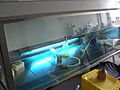 UV disinfection in a laminar flow cabinet
 -
 Germicidal effectiveness curve for UVC LEDs
 -
 ISO 7010 safety sign for UV radiation
 -
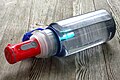 A portable UV water purifier in use
 -
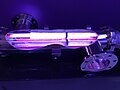 Cutaway model of a UV disinfection unit
 -
 Germicidal effectiveness for low-pressure and medium-pressure mercury lamps
 -
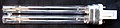 A germicidal lamp
 -
 A UVC LED


References[edit]
<references group="" responsive="1"></references>
-
UVC LED germicidal effectiveness curve
-
ISO 7010 W027
-
Steripen in use
-
Cutaway model of UV disinfection unit used in NEWater water treatment plants
-
Germicidal Effectiveness for LP & MP mercury lamp
-
UVC LED
