Playground slide: Difference between revisions
CSV import |
CSV import |
||
| Line 40: | Line 40: | ||
{{Playground-stub}} | {{Playground-stub}} | ||
<gallery> | |||
File:A girl sliding in Valparaiso, Chile.jpg|A girl sliding in Valparaiso, Chile | |||
File:HaMifletzetGardenNov102022 01.jpg|HaMifletzet Garden | |||
File:1921 Locust yearbook p. 100 (First Grade).jpg|1921 Locust yearbook p. 100 (First Grade) | |||
File:RevPlaygroundSlide GeminiSlideWinder2.jpg|Rev Playground Slide Gemini SlideWinder2 | |||
File:inflatable slide at kemble air day 2008 arp.jpg|Inflatable slide at Kemble Air Day 2008 | |||
File:Templestowe Festival10.jpg|Templestowe Festival | |||
File:Parque Norte(22)-Medellin.JPG|Parque Norte, Medellin | |||
File:Clifton rock slide mh.jpg|Clifton rock slide | |||
File:Two children preparing to use a curving playground slide, 1963.jpg|Two children preparing to use a curving playground slide, 1963 | |||
</gallery> | |||
Latest revision as of 17:48, 3 March 2025
Playground slide or slide is a piece of equipment commonly found in playgrounds, parks, schools, and backyards across the world. It is designed for children, allowing them to climb to the top of the slide via a ladder or stairs and then slide down a smooth, inclined surface to the ground. Slides can be made from various materials, including metal, plastic, or wood, and come in many shapes and sizes, ranging from straight and simple designs to more complex structures with twists, turns, and tunnels.
History[edit]
The concept of the playground slide is rooted in ancient history, with early versions appearing in European landscapes in the 17th century. These early slides were constructed from wood and were primarily found in the gardens of the aristocracy. The modern playground slide, as we know it today, began to emerge in the late 19th and early 20th centuries with the rise of public playgrounds. The playground movement, which aimed to provide safe and constructive play areas for urban children, contributed significantly to the slide's popularity and development.
Types of Slides[edit]
There are several types of playground slides, each offering a different experience:
- Straight Slide: The most basic form, consisting of a straight, inclined plane.
- Spiral Slide: Features a helical descent, offering a longer ride in a compact area.
- Tube Slide: Enclosed slide, providing a dark, tunnel-like experience.
- Wave Slide: Contains undulations, offering a bumpy ride.
- Freeform Slide: Custom-designed slides that do not fit into the standard categories, often featuring unique shapes and paths.
Materials[edit]
Playground slides are constructed from various materials, each offering different benefits and challenges:
- Metal: Durable and strong, but can become very hot in direct sunlight.
- Plastic: Weather-resistant and less likely to reach extreme temperatures, but may fade and become brittle over time.
- Wood: Offers a natural aesthetic, but requires regular maintenance to prevent rot and splintering.
Safety[edit]
Safety is a paramount concern in the design and installation of playground slides. Proper safety measures include ensuring adequate cushioning material, such as wood chips, sand, or rubber mulch, at the base of the slide to absorb impact. Additionally, slides should be inspected regularly for any signs of wear or damage, such as cracks, rust, or splinters, which could pose a risk to children.
Social and Developmental Benefits[edit]
Beyond the sheer joy and excitement they provide, slides also offer several social and developmental benefits for children. Sliding requires turn-taking, promoting social interaction and cooperation among peers. The physical activity involved in climbing and sliding supports gross motor skill development, balance, and coordination. Furthermore, navigating the climb and anticipating the descent can help children develop confidence and overcome fears.
See Also[edit]
References[edit]
<references/>
-
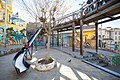 A girl sliding in Valparaiso, Chile
 -
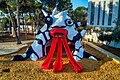 HaMifletzet Garden
 -
 1921 Locust yearbook p. 100 (First Grade)
 -
 Rev Playground Slide Gemini SlideWinder2
 -
 Inflatable slide at Kemble Air Day 2008
 -
 Templestowe Festival
 -
 Parque Norte, Medellin
 -
 Clifton rock slide
 -
 Two children preparing to use a curving playground slide, 1963


.jpg)


-Medellin.JPG)


