NanoPutian: Difference between revisions
CSV import |
CSV import Tags: mobile edit mobile web edit |
||
| Line 26: | Line 26: | ||
{{Chemistry-stub}} | {{Chemistry-stub}} | ||
<gallery> | |||
File:Synthesis_of_a_NanoPutians_Upper_Body_FIXED_-2.png|Synthesis of a NanoPutian's Upper Body | |||
File:NanoPutians_Lower_Body_ACS_2(FIXED).png|NanoPutians Lower Body | |||
File:Chemdraw_Attachment_upper_body_lower_body.png|Chemdraw Attachment Upper Body Lower Body | |||
File:Chemdraw_Nanokid.png|Chemdraw Nanokid | |||
File:Nanoprofessional_table2.png|Nanoprofessional Table | |||
File:NanoPutian_Standing.png|NanoPutian Standing | |||
File:Synthesis_of_the_NanoKid_with_Thiol_Feet,_in_Protected_Form_(FIXED)_2.png|Synthesis of the NanoKid with Thiol Feet, in Protected Form | |||
File:Scheme_11_(1)_FIXED.png|Scheme 11 | |||
File:Scheme_11_continued_(1)_(FIXED).png|Scheme 11 Continued | |||
</gallery> | |||
Latest revision as of 12:18, 18 February 2025
NanoPutians are a series of organic molecules whose structural formulae resemble human forms. First synthesized in 2003 by a research team led by James Tour at Rice University, NanoPutians represent a playful yet profound foray into the field of nanotechnology and organic chemistry, illustrating the potential for creating complex molecular structures with specific functions. The name "NanoPutian" is derived from the tiny, humanoid appearance of these molecules, reminiscent of the fictional inhabitants of Jonathan Swift's Gulliver's Travels.
Overview[edit]
NanoPutians are constructed using a combination of organic synthesis techniques, particularly those involving the formation of carbon-carbon bonds. The base structure of a NanoPutian consists of a phenyl group forming the head, a series of carbon atoms creating a torso and limbs, and additional functional groups that determine the molecule's specific properties and applications. This innovative approach to molecular design not only showcases the versatility of organic synthesis but also opens up new avenues for the development of nanoscale devices and materials.
Synthesis[edit]
The synthesis of NanoPutians involves several key steps, starting with the creation of the "body" through a series of reactions that establish the core carbon framework. This is followed by the attachment of the "head," typically a phenyl group, and the "limbs," which are constructed using various carbon chain extensions. The final step involves the addition of functional groups that can alter the physical, chemical, or biological properties of the NanoPutians, making them suitable for a wide range of applications.
Applications[edit]
While initially created as a novel demonstration of synthetic chemistry's capabilities, NanoPutians have potential applications in several fields. In nanomedicine, for example, they could be designed to interact with biological systems in specific ways, such as drug delivery agents that target diseased cells without affecting healthy ones. In materials science, NanoPutians could be used to create new types of nanomaterials with unique mechanical, electrical, or optical properties.
Challenges and Future Directions[edit]
Despite their promise, the practical application of NanoPutians faces several challenges. The complexity of their synthesis limits the scalability of production, making it difficult to produce them in quantities sufficient for commercial or industrial use. Additionally, the long-term stability and biocompatibility of these molecules in real-world environments remain areas of active research.
Future research on NanoPutians is likely to focus on simplifying their synthesis, increasing their stability, and exploring their potential in various applications. As the field of nanotechnology continues to evolve, NanoPutians stand as a testament to the creativity and ingenuity of scientists in manipulating the very building blocks of matter.
See Also[edit]

-
 Synthesis of a NanoPutian's Upper Body
 -
 NanoPutians Lower Body
 -
 Chemdraw Attachment Upper Body Lower Body
 -
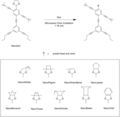 Chemdraw Nanokid
 -
 Nanoprofessional Table
 -
 NanoPutian Standing
 -
 Synthesis of the NanoKid with Thiol Feet, in Protected Form
 -
 Scheme 11
 -
 Scheme 11 Continued

.png)


_2.png)
_FIXED.png)
_(FIXED).png)
