N-Acetylglutamic acid: Difference between revisions
CSV import Tags: mobile edit mobile web edit |
CSV import |
||
| Line 23: | Line 23: | ||
[[Category:Biochemistry]] | [[Category:Biochemistry]] | ||
{{Biochemistry-stub}} | {{Biochemistry-stub}} | ||
<gallery> | |||
File:NAG_at_physiological.png|N-Acetylglutamic acid at physiological pH | |||
File:NAG_protons_exploded_(corrected).png|N-Acetylglutamic acid protons exploded view | |||
File:NAG_HNMR.png|N-Acetylglutamic acid H NMR spectrum | |||
File:NAG_CNMR_2.png|N-Acetylglutamic acid C NMR spectrum | |||
</gallery> | |||
Latest revision as of 04:29, 18 February 2025
N-Acetylglutamic acid (NAG) is a crucial biochemical compound in the urea cycle and nitrogen metabolism. It acts as an essential allosteric activator for carbamoyl phosphate synthetase 1 (CPS1), the first enzyme in the urea cycle. This activation is vital for the conversion of ammonia into urea, thereby preventing the accumulation of toxic ammonia levels in the body. N-Acetylglutamic acid is synthesized from glutamate and acetyl-CoA by the enzyme N-acetylglutamate synthase (NAGS).
Biochemical Role[edit]
N-Acetylglutamic acid plays a pivotal role in the urea cycle, a series of biochemical reactions that occur in the liver. The urea cycle is responsible for the detoxification of ammonia, a byproduct of protein metabolism, converting it into urea which is then excreted in the urine. NAG activates CPS1, enabling the condensation of ammonia with bicarbonate to form carbamoyl phosphate, which enters the urea cycle. Without adequate levels of NAG, the urea cycle cannot function properly, leading to hyperammonemia, a condition characterized by elevated levels of ammonia in the blood.
Clinical Significance[edit]
Deficiencies in N-acetylglutamic acid due to genetic mutations affecting NAGS can lead to N-acetylglutamate synthase deficiency. This rare autosomal recessive disorder results in an inability to synthesize NAG, impairing the urea cycle and leading to hyperammonemia. Symptoms of NAGS deficiency can include lethargy, vomiting, seizures, and coma, often manifesting shortly after birth. Diagnosis is based on biochemical analysis and genetic testing, and treatment typically involves dietary management to limit ammonia production and supplementation with N-carbamylglutamate, a structural analog of NAG that can activate CPS1.
Pharmacology[edit]
N-Carbamylglutamate, due to its similarity to NAG, is used in the treatment of NAGS deficiency and other urea cycle disorders. It serves as an effective replacement therapy, providing the necessary activation of CPS1 to restore urea cycle function and reduce ammonia levels in the blood.
See Also[edit]
References[edit]
<references />
.svg)
This article is a biochemistry stub. You can help WikiMD by expanding it!
-
 N-Acetylglutamic acid at physiological pH
 -
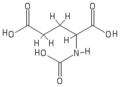 N-Acetylglutamic acid protons exploded view
 -
 N-Acetylglutamic acid H NMR spectrum
 -
 N-Acetylglutamic acid C NMR spectrum

.png)


