Gynandromorphism: Difference between revisions
CSV import Tags: mobile edit mobile web edit |
CSV import |
||
| Line 28: | Line 28: | ||
{{biology-stub}} | {{biology-stub}} | ||
{{medicine-stub}} | {{medicine-stub}} | ||
<gallery> | |||
File:Open_wing_basking_position_of_Gynandromorph_of_Athyma_inara_Westwood,_1850_-_Colour_Sergeant_butterfly_MG_0820_WLB.jpg|Open wing basking position of Gynandromorph of Athyma inara Westwood, 1850 - Colour Sergeant butterfly | |||
File:ZwitterHauhechelblaeuling.jpg|Zwitter Hauhechelblaeuling | |||
File:Heteropteryx_dilatata_0034b_L.D.jpg|Heteropteryx dilatata | |||
File:Gynandromorphism_in_Crocothemis_servilia.jpg|Gynandromorphism in Crocothemis servilia | |||
</gallery> | |||
Latest revision as of 23:57, 24 February 2025
Gynandromorphism is a rare biological phenomenon in which an organism exhibits both male and female physical characteristics. This condition is most commonly observed in insects, such as butterflies, bees, and birds, but can also occur in crustaceans like lobsters and crabs. Gynandromorphism is different from hermaphroditism, where an individual has both male and female reproductive organs; gynandromorphs typically have a split between male and female characteristics, often visibly divided down the middle of their bodies.
Causes[edit]
The causes of gynandromorphism are primarily genetic and can occur in several ways. One common cause is the improper separation of sex chromosomes during the early stages of embryonic development. In species with sex-determination systems such as XY (male) and XX (female), an error in cell division can lead to an organism developing with both XY and XX cells. Environmental factors and mutations can also contribute to the development of gynandromorphic traits, although these instances are less well understood.
Types[edit]
Gynandromorphism can be classified into two main types: bilateral and mosaic.
- Bilateral gynandromorphism is the most visually striking form, where one side of the organism displays male characteristics, and the other side displays female characteristics. This type is especially noticeable in species with distinct sexual dimorphism, such as many types of birds and butterflies.
- Mosaic gynandromorphism involves a more mixed distribution of male and female characteristics throughout the organism's body. This type can be harder to identify without genetic testing, as the distribution of male and female traits is not as clear-cut as in bilateral gynandromorphism.
Implications[edit]
Gynandromorphism has various implications for the organisms it affects. In many cases, gynandromorphs are sterile, as their reproductive systems are not fully functional. The condition also offers unique insights into the development and function of sex-specific traits and behaviors. For example, studying gynandromorphic birds can help scientists understand how hormones influence plumage and song patterns associated with one sex or the other.
Research and Observation[edit]
Gynandromorphism is a subject of interest in both genetics and evolutionary biology. Researchers study gynandromorphs to gain insights into the mechanisms of sex determination and differentiation. Observations of gynandromorphic individuals in the wild can also provide valuable information on how these organisms interact with their environment and with other members of their species, including mating behaviors and survival strategies.
See Also[edit]

-
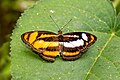 Open wing basking position of Gynandromorph of Athyma inara Westwood, 1850 - Colour Sergeant butterfly
 -
 Zwitter Hauhechelblaeuling
 -
 Heteropteryx dilatata
 -
Gynandromorphism in Crocothemis servilia


