Display device: Difference between revisions
CSV import |
CSV import |
||
| Line 37: | Line 37: | ||
{{Technology-stub}} | {{Technology-stub}} | ||
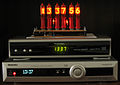
<gallery> | |||
File:Anzeigen(Displays).jpg|Display_device | |||
File:Fallblattanzeigetafel_ausschnitt_ffm_hbf.jpg|Display_device | |||
</gallery> | |||
Latest revision as of 01:34, 18 February 2025
Display device refers to an output device for presenting information in visual or tactile form. When the input information is supplied as an electrical signal, the display is called an electronic display. Common applications for electronic visual displays are television sets or computer monitors.
Types of Display Devices[edit]
There are several types of display devices, each with its own advantages, disadvantages, and applications. The most common types include:
- Cathode Ray Tube (CRT): An older technology that uses electron beams to illuminate phosphors on the inside of a vacuum tube. Cathode Ray Tube displays are bulky and have largely been replaced by more modern technologies.
- Liquid Crystal Display (LCD): Utilizes liquid crystals that are manipulated in a matrix to display images. LCDs are thin, energy-efficient, and provide better color accuracy and resolution than CRTs. They are widely used in monitors, smartphones, and televisions.
- Light Emitting Diode (LED): An advancement of LCD technology, LED displays use light-emitting diodes for backlighting instead of the cold cathode fluorescent (CCFL) lighting used in traditional LCDs. This results in improved color and contrast.
- Organic Light Emitting Diode (OLED): A type of LED where the pixels emit their own light, allowing for deeper blacks and a higher contrast ratio. OLED displays are used in high-end smartphones and TVs.
- Plasma Display Panel (PDP): Uses small cells containing electrically charged ionized gases to display images. Plasma displays were known for their excellent color accuracy and contrast ratios but have been phased out in favor of LCD and OLED technologies.
Applications[edit]
Display devices serve a multitude of applications across various fields. Some of the primary applications include:
- Computing: As monitors for desktop computers, providing an interface for users to interact with the computer systems.
- Telecommunications: In smartphones and tablets, display devices are crucial for user interaction.
- Entertainment: Televisions and projectors use display technologies to present visual media to audiences.
- Advertising: Digital signage and billboards use large-scale display devices to broadcast advertisements and information.
- Medical: Specialized display devices are used in medical equipment for diagnostics and patient monitoring.
Future Trends[edit]
The future of display technology is likely to see further advancements in resolution, energy efficiency, and flexibility. Emerging technologies such as flexible OLED displays and MicroLEDs promise to offer improved performance and new applications, including wearable devices and foldable smartphones.
See Also[edit]
References[edit]
<references/>

-
 Display_device
 -
 Display_device
.jpg)

