Catocala: Difference between revisions
CSV import |
CSV import Tags: mobile edit mobile web edit |
||
| (One intermediate revision by the same user not shown) | |||
| Line 25: | Line 25: | ||
[[Category:Erebidae]] | [[Category:Erebidae]] | ||
{{Lepidoptera-stub}} | {{Lepidoptera-stub}} | ||
<gallery> | |||
File:Catocala_pura.JPG|Catocala pura | |||
File:Catocala_ilia.jpg|Catocala ilia | |||
File:Catocala_actaea_01.jpg|Catocala actaea | |||
File:Catocala_agitatrix.jpg|Catocala agitatrix | |||
File:Catocala_coniuncta.jpg|Catocala coniuncta | |||
File:Catocala_conversa.jpg|Catocala conversa | |||
File:Catocala_dilecta.jpg|Catocala dilecta | |||
File:Catocala_disjuncta.jpg|Catocala disjuncta | |||
File:Catocala_diversa.jpg|Catocala diversa | |||
File:Catocala_electa01.jpg|Catocala electa | |||
File:Catocala_elocata.01.jpg|Catocala elocata | |||
File:Catocala_eutychea.jpg|Catocala eutychea | |||
</gallery> | |||
== Catocala == | |||
<gallery> | |||
File:Catocala_pura.JPG|Catocala | |||
File:Catocala_ilia.jpg|Catocala | |||
File:Catocala_actaea_01.jpg|Catocala | |||
File:Catocala_agitatrix.jpg|Catocala | |||
File:Catocala_coniuncta.jpg|Catocala | |||
File:Catocala_conversa.jpg|Catocala | |||
File:Catocala_dilecta.jpg|Catocala | |||
File:Catocala_disjuncta.jpg|Catocala | |||
File:Catocala_diversa.jpg|Catocala | |||
File:Catocala_electa01.jpg|Catocala | |||
File:Catocala_elocata.01.jpg|Catocala | |||
File:Catocala_eutychea.jpg|Catocala | |||
</gallery> | |||
Latest revision as of 12:08, 18 February 2025
Catocala is a genus of moths belonging to the family Erebidae, commonly known as the underwing moths. This genus is notable for its species' distinctive wing patterns and colors, which serve as a primary example of camouflage and mimicry in the animal kingdom. The name Catocala derives from the Greek words kato, meaning "below," and kalos, meaning "beautiful," referring to the strikingly colored hindwings concealed beneath their more cryptic forewings.
Description[edit]
Catocala moths are medium to large in size, with wingspans ranging from 3 to 15 cm. The forewings are typically drab-colored, featuring shades of gray, brown, or black, which allow them to blend seamlessly with their surroundings, such as tree bark. In contrast, the hindwings are vividly colored, with red, orange, blue, or yellow hues, often adorned with black bands or spots. This dramatic coloration is usually hidden when the moth is at rest, but when disturbed, the moth reveals its bright hindwings, potentially startling predators and giving the moth a chance to escape.
Habitat and Distribution[edit]
Catocala moths are found worldwide, with a significant number of species residing in North America. They inhabit a variety of ecosystems, including forests, woodlands, and prairies. These moths are nocturnal and are most commonly seen during the late summer and early fall months.
Life Cycle[edit]
The life cycle of Catocala moths includes four stages: egg, larva (caterpillar), pupa, and adult. Females lay eggs on the bark of host trees or shrubs. Upon hatching, the caterpillars feed on the leaves of their host plants, which include species of Populus (poplars), Salix (willows), and Quercus (oaks). After several weeks of feeding and growth, the caterpillar pupates, forming a cocoon in which it will transform into an adult moth. This metamorphosis can take several weeks to months, depending on environmental conditions.
Behavior[edit]
Catocala moths are primarily nocturnal and are attracted to light sources at night. During the day, they rely on their camouflage to protect them from predators. When threatened, they flash their brightly colored hindwings, a behavior known as "startle display," which may deter predators such as birds and bats.
Conservation[edit]
While many Catocala species are common and not currently at risk, habitat destruction and pollution pose threats to some species. Conservation efforts focus on preserving natural habitats and promoting biodiversity to ensure the survival of these and other moth species.
See Also[edit]
.svg)
-
 Catocala pura
 -
 Catocala ilia
 -
 Catocala actaea
 -
 Catocala agitatrix
 -
 Catocala coniuncta
 -
 Catocala conversa
 -
 Catocala dilecta
 -
 Catocala disjuncta
 -
 Catocala diversa
 -
 Catocala electa
 -
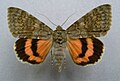 Catocala elocata
 -
 Catocala eutychea


Catocala[edit]
-
Catocala
-
Catocala
-
Catocala
-
Catocala
-
Catocala
-
Catocala
-
Catocala
-
Catocala
-
Catocala
-
Catocala
-
Catocala
-
Catocala
