Generalized normal distribution: Difference between revisions
CSV import Tags: mobile edit mobile web edit |
CSV import |
||
| Line 40: | Line 40: | ||
[[Category:Statistical distributions]] | [[Category:Statistical distributions]] | ||
{{mathematics-stub}} | {{mathematics-stub}} | ||
<gallery> | |||
File:Generalized_normal_densities.svg|Probability density functions of the generalized normal distribution | |||
File:Generalized_normal_cdfs.svg|Cumulative distribution functions of the generalized normal distribution | |||
File:Generalized_normal_densities_2.svg|Generalized normal distribution densities with different parameters | |||
File:Generalized_normal_cdfs_2.svg|Generalized normal distribution cumulative distribution functions with different parameters | |||
</gallery> | |||
Latest revision as of 04:37, 18 February 2025
Generalized Normal Distribution (GND), also known as the Generalized Gaussian Distribution (GGD), is a family of continuous probability distributions that extends the normal (Gaussian) distribution to accommodate for different shapes of the probability density function. The GND is characterized by three parameters: location parameter (μ), scale parameter (β), and shape parameter (α). These parameters allow the GND to model a wide range of data distributions, from the classic bell-shaped curve of the normal distribution to distributions with heavier or lighter tails.
Definition[edit]
The probability density function (PDF) of the Generalized Normal Distribution is given by:
\[f(x | \mu, \alpha, \beta) = \frac{\beta}{2\alpha\Gamma(1/\beta)} \exp\left(-\left(\frac{|x-\mu|}{\alpha}\right)^\beta\right)\]
where:
- \(x\) is the variable,
- \(\mu\) is the location parameter,
- \(\alpha > 0\) is the scale parameter,
- \(\beta > 0\) is the shape parameter,
- \(\Gamma(\cdot)\) is the Gamma function.
Parameters[edit]
- The location parameter \(\mu\) determines the center of the distribution.
- The scale parameter \(\alpha\) controls the spread of the distribution.
- The shape parameter \(\beta\) influences the shape of the distribution's tails and peak. For \(\beta = 2\), the GND becomes the standard normal distribution. Values of \(\beta < 2\) result in distributions with heavier tails than the normal distribution, while \(\beta > 2\) leads to distributions with lighter tails.
Properties[edit]
Moments[edit]
The nth moment of the Generalized Normal Distribution can be expressed in terms of the location, scale, and shape parameters, but the expressions become increasingly complex for higher moments.
Entropy[edit]
The entropy of the GND, a measure of the uncertainty represented by the distribution, can also be calculated based on its parameters.
Applications[edit]
The Generalized Normal Distribution is used in various fields, including signal processing, image processing, and finance, where data may not follow the standard normal distribution. Its flexibility in modeling different types of data distributions makes it a valuable tool for statistical analysis.
See Also[edit]
References[edit]
<references/>

This article is a mathematics-related stub. You can help WikiMD by expanding it!
-
 Probability density functions of the generalized normal distribution
 -
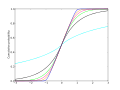 Cumulative distribution functions of the generalized normal distribution
 -
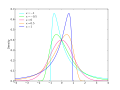 Generalized normal distribution densities with different parameters
 -
Generalized normal distribution cumulative distribution functions with different parameters


