Lithium polymer battery: Difference between revisions
CSV import |
CSV import |
||
| Line 36: | Line 36: | ||
{{Energy-stub}} | {{Energy-stub}} | ||
<gallery> | |||
File:Li_Polymer_Battery_for_iPhone.jpg|Lithium polymer battery for iPhone | |||
File:NASA_Lithium_Ion_Polymer_Battery.jpg|NASA Lithium Ion Polymer Battery | |||
File:Custom_Cells_Itzehoe_GmbH_free_form_factor_battery_for_Unmanned_Underwater_Vehicle_(UUV_AUV).png|Custom Cells Itzehoe GmbH free form factor battery for Unmanned Underwater Vehicle (UUV/AUV) | |||
File:Lithium_polymer_battery_(11.1_volts).jpg|Lithium polymer battery (11.1 volts) | |||
File:Expanded_lithium-ion_polymer_battery_from_an_Apple_iPhone_3GS.jpg|Expanded lithium-ion polymer battery from an Apple iPhone 3GS | |||
File:Schematic_of_a_lithium_polymer_battery_based_on_GPEs.jpg|Schematic of a lithium polymer battery based on GPEs | |||
</gallery> | |||
Latest revision as of 11:35, 18 February 2025
Lithium Polymer Battery
A Lithium Polymer Battery, often abbreviated as LiPo, is a rechargeable battery of lithium-ion technology using a polymer electrolyte instead of a liquid electrolyte. High conductivity semisolid polymers form this electrolyte. These batteries are widely used in applications where weight and space are critical factors like in mobile devices, drones, electric vehicles, and radio-controlled equipment.
History[edit]
The development of lithium polymer batteries began in the 1970s, following the invention of the lithium-ion battery. Researchers sought to improve safety and energy density by replacing the liquid electrolyte with a solid polymer electrolyte. This led to the first commercial LiPo batteries in the 1990s.
Design and Function[edit]
LiPo batteries are composed of several components: the anode, cathode, electrolyte, separator, and current collectors. The anode is typically made from carbon, the cathode from a lithium metal oxide, and the electrolyte from a lithium salt in a polymer base. The separator is a micro-porous film that keeps the anode and cathode from touching while allowing ions to pass through. LiPo batteries are unique because they can be made in almost any shape and size.
Advantages[edit]
LiPo batteries offer several advantages over traditional lithium-ion and nickel-metal hydride batteries, including higher energy density, lighter weight, and the ability to create batteries in various shapes and sizes. They also have a lower self-discharge rate and do not suffer from the memory effect.
Safety[edit]
While LiPo batteries are generally safe, they can pose a fire risk if damaged, overcharged, or subjected to extreme temperatures. It is crucial to use a proper charging system and to follow the manufacturer's guidelines for use and storage.
Applications[edit]
LiPo batteries are used in a wide range of applications, from consumer electronics like smartphones and laptops to more demanding applications such as electric vehicles and aerospace. Their lightweight and high energy density make them particularly suited for portable devices.
Environmental Impact[edit]
The environmental impact of LiPo batteries includes concerns regarding the extraction of lithium and other metals, the use of hazardous materials, and challenges associated with battery disposal and recycling. Efforts are underway to develop more sustainable and environmentally friendly battery technologies.
Future Directions[edit]
Research into LiPo technology focuses on improving energy density, safety, and lifespan. Innovations such as solid-state electrolytes and new cathode materials hold the promise of making LiPo batteries more efficient, safer, and more environmentally friendly.
See Also[edit]

-
 Lithium polymer battery for iPhone
 -
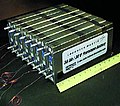 NASA Lithium Ion Polymer Battery
 -
 Custom Cells Itzehoe GmbH free form factor battery for Unmanned Underwater Vehicle (UUV/AUV)
 -
 Lithium polymer battery (11.1 volts)
 -
 Expanded lithium-ion polymer battery from an Apple iPhone 3GS
 -
 Schematic of a lithium polymer battery based on GPEs


.png)
.jpg)


