Jump wire: Difference between revisions
CSV import Tags: mobile edit mobile web edit |
CSV import |
||
| Line 37: | Line 37: | ||
{{Electronics-stub}} | {{Electronics-stub}} | ||
== Jump_wire == | |||
<gallery> | |||
File:A_few_Jumper_Wires.jpg|A few jumper wires | |||
File:Jumper_Wires_with_Crocodile_Clips.jpg|Jumper wires with crocodile clips | |||
File:Arduino_Breadboard_ATmega328P_USB2Serial.jpg|Arduino breadboard with ATmega328P and USB to serial | |||
</gallery> | |||
Latest revision as of 03:54, 18 February 2025
Jump wire (also known as jumper wire, jumper, or jumper cable) is a short electrical wire or conductor with a connector or pin at each end, which is typically used to interconnect the components of a breadboard or other prototype or test circuit, internally or with other equipment or components, without soldering. Jump wires are used in electronics and electrical engineering more broadly to establish temporary circuits for testing or to bypass certain sections of a circuit. These wires are fundamental in the development and testing phases of electronic devices, allowing for quick changes and updates to a circuit without the need for permanent alterations.
Types of Jump Wires[edit]
Jump wires can be categorized based on their design and application:
- Solid-core wires: Made of a single piece of metal wire, usually copper, coated with insulation. They are rigid and maintain their shape, which is useful for breadboarding.
- Stranded wires: Composed of many small strands twisted together, making them more flexible than solid-core wires. They are often used where movement or flexibility is required.
- Pre-crimped wires: These jump wires have pre-attached connectors or pins, making them ready to use for connecting components like microcontrollers, sensors, and other electronic modules.
- Ribbon cables: Consist of multiple jump wires parallel to each other on the same flat plane. They are used to connect multichannel systems or devices, maintaining organization and reducing space.
Applications[edit]
Jump wires are extensively used in:
- Prototyping: Essential in the design and testing of circuits on breadboards.
- Debugging: Allows for the temporary bypass of circuit sections to diagnose issues.
- Educational purposes: Used in teaching electronics, allowing students to experiment with circuit designs.
- Repair: Can be used to make temporary connections to test components in repair scenarios.
Considerations[edit]
When using jump wires, several factors should be considered to ensure safety and effectiveness:
- Current rating: The wire gauge (thickness) determines the maximum current it can safely carry.
- Connection quality: Poor connections can lead to intermittent signals or power disruptions.
- Signal integrity: In high-speed circuits, the length and routing of jump wires can affect performance due to resistance, capacitance, and inductance.
See Also[edit]
External Links[edit]

Jump_wire[edit]
-
 A few jumper wires
 -
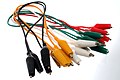 Jumper wires with crocodile clips
 -
 Arduino breadboard with ATmega328P and USB to serial


