Culture of ancient Rome: Difference between revisions
CSV import Tags: mobile edit mobile web edit |
CSV import |
||
| Line 26: | Line 26: | ||
{{Ancient Rome-stub}} | {{Ancient Rome-stub}} | ||
== Culture of ancient Rome gallery == | |||
<gallery> | |||
File:Pompeii family feast painting Naples.jpg|Pompeii family feast painting | |||
File:Scène de banquet, fresque, Herculanum.jpg|Scène de banquet, fresque, Herculanum | |||
File:Giovane con rotolo.JPG|Giovane con rotolo | |||
File:Fresco depicting a seated woman, from the Villa Arianna at Stabiae, Naples National Archaeological Museum (17393152265).jpg|Fresco depicting a seated woman, from the Villa Arianna at Stabiae | |||
File:Togato, I sec dc. con testa di restauro da un ritratto di nerva, inv. 2286.JPG|Togato, I sec dc. con testa di restauro da un ritratto di Nerva | |||
File:Still life with eggs, birds and bronze dishes, Pompeii.jpg|Still life with eggs, birds and bronze dishes, Pompeii | |||
File:Busto maschile.JPG|Busto maschile | |||
File:Roman military diploma Carnuntum 02.jpg|Roman military diploma Carnuntum | |||
File:Choregos actors MAN Napoli Inv9986.jpg|Choregos actors | |||
File:Marek Tuliiusz Cyceron.jpg|Marek Tuliiusz Cyceron | |||
</gallery> | |||
Latest revision as of 06:06, 3 March 2025
Culture of Ancient Rome refers to the social norms, beliefs, traditions, and practices that defined the civilization of Rome from the founding of the city in the 8th century BC to the collapse of the Western Roman Empire in the 5th century AD. This culture was influenced by the Greeks and Etruscans and, in turn, profoundly influenced Western civilization, particularly in the areas of law, government, language, architecture, and engineering.
Social Structure[edit]
The social structure of Ancient Rome was hierarchical, with society divided into several classes, including the Patricians, the Plebeians, and slaves. The Patricians were the wealthy and noble families who held most of the political power, while the Plebeians were the commoners who, over time, fought for and gained significant rights and governmental representation. Slaves were at the bottom of the social hierarchy and were owned by both Patricians and Plebeians.
Religion[edit]
Religion in Ancient Rome was polytheistic, with a pantheon of gods and goddesses influencing every aspect of Roman life. Major deities included Jupiter, the king of the gods; Juno, his wife and goddess of marriage; and Mars, god of war. The Romans also adopted gods from other cultures, such as the Greek god Apollo. Religious practices included sacrifices, festivals, and games held in honor of the gods.
Education[edit]
Education in Ancient Rome was primarily the responsibility of the family. Wealthy families employed tutors to educate their children, while poorer families often could not afford formal education. Boys were taught reading, writing, arithmetic, and rhetoric, while girls were educated in domestic skills. Higher education was available in the form of rhetoric and philosophy, taught by Greek tutors.
Entertainment[edit]
Entertainment in Ancient Rome was varied and included Gladiatorial games, chariot races, theater, and public baths. The Colosseum and Circus Maximus were among the most famous venues for public entertainment. These events were not only forms of entertainment but also ways for emperors and politicians to gain public favor.
Architecture and Engineering[edit]
Roman architecture and engineering were among the most enduring achievements of Ancient Rome. Innovations such as the Roman arch, aqueducts, and concrete allowed for the construction of impressive structures like the Pantheon, Colosseum, and extensive road networks. These advancements facilitated the expansion and maintenance of the Roman Empire.
Language and Literature[edit]
Latin, the language of Ancient Rome, is the ancestor of the Romance languages and has influenced English and other languages. Roman literature was heavily influenced by Greek models and included poetry, drama, history, and philosophy. Notable authors include Virgil, Ovid, Cicero, and Seneca.
Legacy[edit]
The culture of Ancient Rome has left a lasting legacy on Western civilization. Roman law and republican government influenced the development of modern democratic institutions. Roman innovations in architecture and engineering continue to inspire modern design. The Latin language and Roman literature have had a profound impact on Western literature and languages.

This article is a Ancient Rome-related stub. You can help WikiMD by expanding it!
Culture of ancient Rome gallery[edit]
-
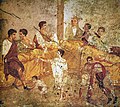 Pompeii family feast painting
 -
 Scène de banquet, fresque, Herculanum
 -
 Giovane con rotolo
 -
 Fresco depicting a seated woman, from the Villa Arianna at Stabiae
 -
 Togato, I sec dc. con testa di restauro da un ritratto di Nerva
 -
 Still life with eggs, birds and bronze dishes, Pompeii
 -
 Busto maschile
 -
 Roman military diploma Carnuntum
 -
 Choregos actors
 -
 Marek Tuliiusz Cyceron


.jpg)


