Cystocarp: Difference between revisions
CSV import |
CSV import |
||
| Line 21: | Line 21: | ||
{{Algae-stub}} | {{Algae-stub}} | ||
== Cystocarp == | |||
<gallery> | |||
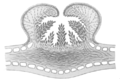
File:Amphiplexia_hymenocladioides.png|Amphiplexia hymenocladioides | |||
</gallery> | |||
Latest revision as of 21:00, 25 February 2025
Cystocarp is a specialized structure found in certain types of red algae, specifically within the Rhodophyta division. It plays a crucial role in the reproductive cycle of these algae, serving as the site where spores are produced and eventually released. The formation of a cystocarp is a hallmark of the sexual reproduction process in red algae, marking a complex life cycle that includes both haploid and diploid phases.
Formation[edit]
The cystocarp develops after the fertilization of the female gamete by the male gamete. In red algae, the female gametophyte produces a structure called a carpogonium, which is the site of fertilization. Upon successful fertilization, the carpogonium undergoes several divisions and transformations, eventually leading to the formation of the cystocarp. This structure is often enveloped by protective layers and contains the carpospores, which are diploid spores that will eventually give rise to new diploid individuals, thus completing the life cycle.
Structure[edit]
A cystocarp typically consists of a protective outer layer, the gonimoblast filaments which are involved in the production of carpospores, and the carpospores themselves. The specific structure and complexity of a cystocarp can vary significantly among different species of red algae. Some species may have simple cystocarps with a few carpospores, while others may have highly complex structures containing numerous spores.
Function[edit]
The primary function of the cystocarp is to produce and release carpospores. These spores are released into the water column, where they settle and grow into new diploid individuals, known as the tetrasporophyte stage of the red algae. This stage is crucial for the dispersal and propagation of the species, allowing red algae to colonize new areas and maintain genetic diversity within populations.
Ecological Significance[edit]
Cystocarps and the red algae that produce them play significant roles in marine ecosystems. Red algae are important primary producers, contributing to the base of the food web. They also provide habitat and shelter for various marine organisms. The reproductive success of red algae, facilitated by structures like the cystocarp, is essential for the sustainability of these ecosystems.
Research and Applications[edit]
Research on cystocarps and red algae reproduction has implications for understanding marine biodiversity, ecosystem dynamics, and the potential impacts of climate change on marine habitats. Additionally, red algae are of commercial interest for their gelatinous compounds, such as agar and carrageenan, which are used in food, cosmetics, and pharmaceutical industries. Understanding the life cycle and reproductive strategies of red algae, including the formation and function of cystocarps, is crucial for the sustainable management and exploitation of these resources.

Cystocarp[edit]
-
 Amphiplexia hymenocladioides

