Manchineel: Difference between revisions
CSV import Tags: mobile edit mobile web edit |
CSV import |
||
| Line 34: | Line 34: | ||
{{medicine-stub}} | {{medicine-stub}} | ||
<gallery> | |||
File:Hippomane_mancinella_(fruit).jpg|Manchineel fruit | |||
File:Botanical_study_-_The_Manzanilla_Tree_taken_at_Bocca_chica_-_Botanical-k06526.jpg|Botanical study of the Manchineel tree | |||
File:Do_not_touch_the_Manchineel!.jpg|Warning sign: Do not touch the Manchineel! | |||
</gallery> | |||
Latest revision as of 04:16, 18 February 2025
Manchineel (Hippomane mancinella) is a highly toxic tree native to the tropical parts of the Americas, including the Caribbean. The name "manchineel" as well as the species name "mancinella" is derived from the Spanish word manzanilla, meaning "little apple," due to the superficial resemblance of its fruit to an apple. However, every part of the tree is extremely poisonous to humans and many animals. The manchineel tree is listed in the Guinness World Records as the world's most dangerous tree.
Description[edit]
The manchineel tree grows up to 15 meters (49 ft) tall. It has a greyish bark, shiny green leaves, and small greenish-yellow flowers. The fruit, which resembles a small apple, is especially dangerous. Despite its inviting appearance, it contains powerful toxins that can cause severe burning and irritation upon contact.
Habitat[edit]
Manchineel trees are found in coastal, sandy soils of the tropical parts of the Americas, including South Florida, the Caribbean, Central America, and northern South America. They often grow in mangrove areas, contributing to the coastal ecosystem but posing a risk to humans and animals unfamiliar with its toxic properties.
Toxicity[edit]
Every part of the manchineel tree is poisonous. The milky white sap contains skin irritants, producing strong allergic dermatitis. Standing under the tree during rain can cause blistering of the skin from mere contact with this liquid. Even a small amount of sap in the eyes can lead to temporary blindness, a condition sometimes called "manchineel blindness."
The fruit, although seemingly edible, is highly toxic. Ingestion can cause severe gastrointestinal distress, including vomiting, diarrhea, and in some cases, it can be fatal. The indigenous peoples of the Americas used the sap of the manchineel tree to poison their arrows, and it is said that they would tie captives to the trunk of the tree as a form of execution.
Interaction with Humans[edit]
Due to its dangerous properties, the manchineel tree is often marked with warning signs or painted with a red band to alert people to its presence and toxicity. In some areas, the trees are removed to prevent accidental poisonings.
Conservation[edit]
Despite its toxicity to humans and animals, the manchineel tree plays a vital role in its ecosystem. It helps stabilize sandy soil, protecting coastlines from erosion. Conservation efforts focus on preserving its habitat while managing the risks to humans and animals.
Medical Use[edit]
Interestingly, some components of the manchineel tree have been studied for potential medical applications, including the treatment of tumors. However, research is in the early stages, and the tree's toxic nature makes it a challenging subject for study.
See Also[edit]
References[edit]
<references/>

-
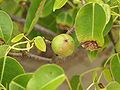 Manchineel fruit
 -
 Botanical study of the Manchineel tree
 -
 Warning sign: Do not touch the Manchineel!
.jpg)


