Heaving to: Difference between revisions
CSV import |
CSV import |
||
| Line 34: | Line 34: | ||
[[Category:Nautical terms]] | [[Category:Nautical terms]] | ||
{{sailing-stub}} | {{sailing-stub}} | ||
<gallery> | |||
File:Hove-to.svg|Hove-to | |||
File:The opium clipper Lanrick.jpg|The opium clipper Lanrick | |||
</gallery> | |||
Latest revision as of 05:24, 3 March 2025
Heaving to is a sailing maneuver used to slow a sailboat's forward progress, as well as to maintain a more stable position in heavy weather conditions. The technique involves positioning the sails and the rudder in such a way that they counteract each other, effectively stopping the boat's forward motion and allowing it to "drift" sideways. This maneuver is particularly useful in storm conditions, providing a safer and more controlled environment for the crew to manage the vessel.
Overview[edit]
Heaving to involves a series of steps that vary slightly depending on the type of sailboat and its rigging. However, the basic principle remains the same: to create a balance of forces between the sails and the rudder that stops the boat's forward movement. This is achieved by backing the jib (the forward sail) and locking the rudder in a position that is opposite to the direction of the backed sail. The mainsail is usually sheeted in tightly and may be centered or slightly to one side, depending on the boat and conditions.
Purpose[edit]
The primary purposes of heaving to are to:
- Provide a rest for the crew during long passages or in heavy weather.
- Make emergency repairs or address issues onboard without the boat making forward progress.
- Wait out a storm with more stability and less strain on the vessel and crew.
- Create a more stable platform for medical emergencies or to assist in man-overboard recovery operations.
Procedure[edit]
While the specific steps to heave to can vary, the general procedure is as follows:
- The boat is turned into the wind (a maneuver known as "tacking") without releasing the jib sheet.
- Once the boat has tacked, the jib is backwinded, meaning it fills with wind from the "wrong" side.
- The helm (rudder) is then turned and locked to the opposite side of the backwinded jib. This action creates a counteracting force against the wind in the jib.
- The mainsail is adjusted so that it is sheeted in tightly, often centered or slightly to one side, depending on the boat's response and the sea conditions.
Considerations[edit]
When heaving to, several factors must be considered for the maneuver to be effective:
- The type of sailboat and its rigging configuration can affect how the boat should be positioned.
- Sea state and wind conditions may require adjustments to the standard procedure.
- The duration for which the boat will be heaved to, as prolonged periods may necessitate additional measures to ensure the safety and comfort of the crew.
Safety[edit]
Heaving to is considered a safe haven maneuver in heavy weather sailing. It reduces the wear and tear on the vessel and the risk of crew fatigue or injury. However, it is essential for sailors to practice this maneuver in various conditions to understand how their particular vessel responds.
In Literature and Practice[edit]
The technique of heaving to has been documented in numerous sailing manuals and literature, highlighting its importance in seamanship. It is a skill that sailors of all levels should master, as it can be crucial for safety in challenging conditions.

-
 Hove-to
 -
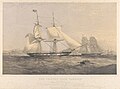 The opium clipper Lanrick


