Bridgman–Stockbarger method: Difference between revisions
CSV import Tags: mobile edit mobile web edit |
CSV import |
||
| Line 31: | Line 31: | ||
{{materials-science-stub}} | {{materials-science-stub}} | ||
== Bridgman–Stockbarger method == | |||
<gallery> | |||
File:Bridgman-Stockbarger-Technique.svg|Diagram illustrating the Bridgman–Stockbarger technique. | |||
</gallery> | |||
Latest revision as of 22:15, 16 February 2025
Bridgman–Stockbarger method
The Bridgman–Stockbarger method is a widely used technique in the field of materials science for the production of single crystals. This method, named after its inventors, Percy Williams Bridgman and Donald C. Stockbarger, is particularly significant for its application in the growth of large, high-quality crystals. These crystals are essential for various applications, including semiconductor manufacturing, laser technology, and crystallography.
Overview[edit]
The Bridgman–Stockbarger method involves the controlled cooling of a molten material to promote the growth of a single crystal. This process is typically carried out in a furnace with a specially designed temperature gradient. The material to be crystallized is placed in a crucible, which is then slowly moved from the hotter region of the furnace to the cooler region. This movement allows the material to solidify gradually, starting from a single nucleation point, and grow into a large single crystal.
Process[edit]
The process begins with the preparation of the material, which is purified and placed into a crucible. The crucible is then positioned in the hot zone of the furnace. The furnace is designed to have a sharp temperature gradient, with the hot zone at a temperature just above the melting point of the material and the cool zone at a temperature below the solidification point.
As the crucible is slowly moved or lowered into the cooler zone, the material begins to solidify from the bottom up. The key to the Bridgman–Stockbarger method is the controlled rate of movement and the temperature gradient, which allows for the formation of a single crystal. The slower the movement and the steeper the temperature gradient, the better the quality of the crystal produced.
Applications[edit]
The Bridgman–Stockbarger method is used to grow a wide variety of single crystals, including metals, semiconductors, and insulators. Some of the most common materials grown using this method are silicon, germanium, gallium arsenide, and sapphire. These crystals are essential components in the electronics industry, used in devices such as transistors, diodes, and LED lights. Additionally, large single crystals of certain materials are used in research applications, such as neutron and X-ray diffraction studies.
Advantages and Limitations[edit]
One of the main advantages of the Bridgman–Stockbarger method is its ability to produce large, high-quality single crystals. The method is relatively simple and cost-effective, making it suitable for industrial-scale production. However, there are some limitations to this technique. The quality of the crystal can be affected by the presence of impurities in the material or by fluctuations in the temperature gradient. Additionally, the method is not suitable for all materials, particularly those with high vapor pressures or those that decompose before melting.
See Also[edit]
References[edit]
<references/>
This article is a Materials science-related stub. You can help WikiMD by expanding it!
Bridgman–Stockbarger method[edit]
-
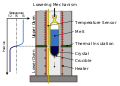 Diagram illustrating the Bridgman–Stockbarger technique.

