Pleckstrin: Difference between revisions
CSV import Tags: mobile edit mobile web edit |
No edit summary |
||
| (2 intermediate revisions by the same user not shown) | |||
| Line 22: | Line 22: | ||
[[Category:Immunology]] | [[Category:Immunology]] | ||
{{stb}} | {{stb}} | ||
== Pleckstrin == | |||
<gallery> | |||
File:2I5C_pleckstrin.png|2I5C pleckstrin | |||
</gallery> | |||
Latest revision as of 00:57, 17 March 2025
Pleckstrin is a protein that plays a significant role in cellular signaling processes, particularly within the context of blood platelet activation and the immune response. It was first identified in platelets, where it was observed to be a major substrate for protein kinase C, a key enzyme involved in signal transduction pathways. The name "pleckstrin" is derived from "platelet and leukocyte C kinase substrate," reflecting its initial identification and function.
Structure and Function[edit]
Pleckstrin is characterized by the presence of two Pleckstrin Homology (PH) domains, which are common structural domains in proteins involved in intracellular signaling processes. These PH domains enable pleckstrin to bind to phosphatidylinositol lipids in the cell membrane, facilitating its role in signaling pathways. The protein also contains a central DEP (Dishevelled, Egl-10, and Pleckstrin) domain, which may be involved in membrane localization and protein-protein interactions.
The primary function of pleckstrin is to mediate the interactions between signaling proteins and the cell membrane, thereby playing a crucial role in the regulation of cell activation, migration, and proliferation. In platelets, pleckstrin's phosphorylation by protein kinase C is a critical step in the activation process, leading to platelet aggregation and blood clot formation. In immune cells, pleckstrin is involved in the signaling pathways that control cell activation and the immune response.
Clinical Significance[edit]
Alterations in pleckstrin expression or function have been implicated in various diseases, including cancer, cardiovascular diseases, and immune disorders. For example, overexpression of pleckstrin has been observed in certain types of cancer, suggesting a potential role in tumor progression and metastasis. In cardiovascular diseases, abnormal pleckstrin signaling can affect platelet function, leading to increased risk of thrombosis and other complications.
Research and Therapeutic Potential[edit]
Given its central role in critical cellular processes, pleckstrin is a target of interest for therapeutic intervention. Inhibitors or modulators of pleckstrin function could potentially be developed to treat diseases associated with abnormal cell signaling, such as cancer and thrombotic disorders. Research in this area is ongoing, with the aim of understanding the precise mechanisms by which pleckstrin contributes to disease and identifying potential targets for drug development.
See Also[edit]
| This article is a stub. You can help WikiMD by registering to expand it. |
Pleckstrin[edit]
-
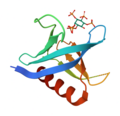 2I5C pleckstrin

