Pupilometer: Difference between revisions
CSV import Tags: mobile edit mobile web edit |
CSV import |
||
| Line 35: | Line 35: | ||
[[Category:Ophthalmology]] | [[Category:Ophthalmology]] | ||
[[Category:Optometry]] | [[Category:Optometry]] | ||
== Pupilometer == | |||
<gallery> | |||
File:Pupillometer_neurolight.jpg|Pupilometer | |||
File:NeurOptics'_NPi-300_Automated_Pupillometer.png|NeurOptics' NPi-300 Automated Pupillometer | |||
File:NeurOptics'_NPi-300_Screens.png|NeurOptics' NPi-300 Screens | |||
</gallery> | |||
Latest revision as of 03:56, 18 February 2025
Pupilometer
A pupilometer is a medical device used primarily by optometrists and ophthalmologists to measure the distance between the human pupils, a measurement known as the pupillary distance (PD). This measurement is crucial for the accurate fitting of eyeglasses.
Function[edit]
The pupilometer functions by emitting a beam of light towards the eye. The light is reflected back from the cornea and captured by the device, which then calculates the distance between the pupils. The measurement is typically given in millimeters.
Types of Pupilometers[edit]
There are two main types of pupilometers: digital and manual.
Digital Pupilometers: These are the most commonly used type of pupilometer. They provide a digital readout of the pupillary distance and are generally more accurate than manual devices.
Manual Pupilometers: These devices require the user to manually adjust the device to measure the pupillary distance. They are less commonly used due to their lower accuracy.
Usage[edit]
Pupilometers are primarily used in the field of optometry and ophthalmology. They are essential for ensuring that eyeglasses and contact lenses are properly fitted to the individual's eyes. Incorrect pupillary distance can lead to eye strain, headaches, and blurred vision.
See Also[edit]
References[edit]
<references />

Pupilometer[edit]
-
 Pupilometer
 -
 NeurOptics' NPi-300 Automated Pupillometer
 -
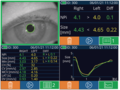 NeurOptics' NPi-300 Screens


