Lumbee: Difference between revisions
CSV import |
CSV import |
||
| Line 28: | Line 28: | ||
[[Category:State recognized tribes in the United States]] | [[Category:State recognized tribes in the United States]] | ||
[[Category:Lumbee]] | [[Category:Lumbee]] | ||
<gallery> | |||
File:Three_Lumbee_c._1909.jpg|Three Lumbee, circa 1909 | |||
File:White_men_and_Robeson_County_indians_(Lumbee_Indians)_in_fight-armed_skirmish_(State's_Exhibit_No.6)._Photo_taken_by_Bill_Shaw,_Fayetteville_Observer_newspaper_photographer._Photo_used_as_state's_(8224422682).jpg|White men and Robeson County Indians (Lumbee Indians) in fight-armed skirmish | |||
File:DOLE,_MCINTYRE_TESTIFY_AT_LUMBEE_HEARING.jpg|Dole, McIntyre testify at Lumbee hearing | |||
File:10th_Annual_Lumbee_Powwow_Lumberton.jpg|10th Annual Lumbee Powwow, Lumberton | |||
File:Lumbee_Homecoming_2016_vendors.png|Lumbee Homecoming 2016 vendors | |||
File:Collard_sandwiches.png|Collard sandwiches | |||
</gallery> | |||
Latest revision as of 11:34, 18 February 2025
Lumbee is a tribe of Native American people recognized at the state level in North Carolina. The Lumbee tribe is the largest tribe in North Carolina, the largest tribe east of the Mississippi River, and the ninth largest in the nation. The Lumbee take their name from the Lumbee River which winds its way through Robeson County in North Carolina, where the tribe primarily resides.
History[edit]
The Lumbee tribe's history is marked by a struggle for federal recognition. Despite numerous attempts to gain full federal recognition, the Lumbee remain recognized only at the state level. The tribe's history is intertwined with the history of Robeson County, where most Lumbee live. The Lumbee have been recognized as a tribe by the state of North Carolina since 1885, but have been seeking full federal recognition since 1888.
Culture[edit]
The Lumbee tribe has a rich and vibrant culture, with a strong emphasis on community, family, and respect for their heritage. The tribe's culture is a blend of the various indigenous, European, and African cultures that have influenced the Lumbee people over the centuries. The Lumbee are known for their distinctive arts and crafts, music, dance, and cuisine.
Health[edit]
Like many indigenous communities, the Lumbee tribe faces a number of health challenges. These include higher rates of diabetes, heart disease, and certain types of cancer compared to the general population. The tribe has taken steps to address these health disparities, including the establishment of the Lumbee Tribe Healthy Start Program and the Lumbee Tribe Diabetes Program.
Education[edit]
Education is highly valued in the Lumbee community. The tribe operates several programs aimed at promoting educational achievement among its members, including the Lumbee Tribe Educational Services Program and the Lumbee Tribe Boys and Girls Club.
Notable Lumbee[edit]
There are many notable Lumbee who have made significant contributions to various fields. These include the likes of Henry Berry Lowrie, a legendary figure in Lumbee history, and Oxendine, a prominent Lumbee educator and activist.
See also[edit]
References[edit]
<references />

-
 Three Lumbee, circa 1909
 -
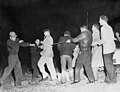 White men and Robeson County Indians (Lumbee Indians) in fight-armed skirmish
 -
 Dole, McIntyre testify at Lumbee hearing
 -
 10th Annual Lumbee Powwow, Lumberton
 -
 Lumbee Homecoming 2016 vendors
 -
 Collard sandwiches

_in_fight-armed_skirmish_(State%27s_Exhibit_No.6)._Photo_taken_by_Bill_Shaw,_Fayetteville_Observer_newspaper_photographer._Photo_used_as_state%27s_(8224422682).jpg)


