NK2 homeobox 1: Difference between revisions
CSV import Tags: mobile edit mobile web edit |
CSV import |
||
| Line 28: | Line 28: | ||
{{medicine-stub}} | {{medicine-stub}} | ||
== NK2_homeobox_1 == | |||
<gallery> | |||
File:Immunohistochemistry_of_adenocarcinoma_with_cytoplasmic_versus_nuclear_staining_for_TTF-1.jpg|Immunohistochemistry of adenocarcinoma with cytoplasmic versus nuclear staining for TTF-1 | |||
File:Lung_adenocarcinoma_-_TTF-1_-_high_mag.jpg|Lung adenocarcinoma - TTF-1 - high magnification | |||
</gallery> | |||
Latest revision as of 21:02, 25 February 2025
NK2 homeobox 1 (also known as NKX2-1) is a protein that in humans is encoded by the NKX2-1 gene. This protein is a transcription factor, which is a type of protein that helps turn specific genes "on" or "off" by binding to nearby DNA.
Function[edit]
NKX2-1 is crucial for the development of the thyroid, lung, and brain in mammals. It is involved in the specification and differentiation of cells in these organs during embryogenesis. In the thyroid, NKX2-1 activates the expression of the genes encoding thyroglobulin and thyroperoxidase, which are essential for thyroid hormone synthesis. In the lung, it regulates the expression of surfactant proteins. In the brain, it is involved in the development of the basal ganglia.
Clinical significance[edit]
Mutations in the NKX2-1 gene can lead to a variety of medical conditions. These include congenital hypothyroidism, respiratory distress syndrome, and benign hereditary chorea, a rare genetic disorder characterized by uncontrolled movements, lung disease, and thyroid disease.
Research[edit]
Research is ongoing to understand the role of NKX2-1 in lung cancer. It is overexpressed in a subset of lung adenocarcinomas, and its expression is associated with a good prognosis.
See also[edit]
References[edit]
<references />

NK2_homeobox_1[edit]
-
 Immunohistochemistry of adenocarcinoma with cytoplasmic versus nuclear staining for TTF-1
 -
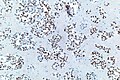 Lung adenocarcinoma - TTF-1 - high magnification


