Rostrum (anatomy): Difference between revisions
From WikiMD's Wellness Encyclopedia
CSV import |
CSV import Tags: mobile edit mobile web edit |
||
| Line 35: | Line 35: | ||
{{anatomy-stub}} | {{anatomy-stub}} | ||
<gallery> | |||
File:Kew_Gardens_-_London_-_September_2008_(2952022283).jpg|Kew Gardens - London - September 2008 | |||
File:Nebalia.svg|Nebalia | |||
File:Washington_DC_Zoo_-_Macrobrachium_rosenbergii_6.jpg|Washington DC Zoo - Macrobrachium rosenbergii | |||
File:Gminatus_australis_with_Beetle.jpg|Gminatus australis with Beetle | |||
File:Architeuthis_beak.jpg|Architeuthis beak | |||
File:Convolvulus_hawk-moth_(Agrius_convolvuli)_2.jpg|Convolvulus hawk-moth (Agrius convolvuli) | |||
File:Wolf_cranium_labelled.jpg|Wolf cranium labelled | |||
File:Istiophorus_platypterus_.jpg|Istiophorus platypterus | |||
</gallery> | |||
Latest revision as of 23:49, 24 February 2025
Rostrum (anatomy)
The rostrum is a term used in anatomy to refer to a part of an animal's body that sticks out forward from the head. The term is derived from the Latin word for "beak" and is used in various contexts in different animals. In humans, the term "rostrum" is used to refer to several different structures.
In Humans[edit]
In human anatomy, the term "rostrum" is used to refer to several different structures. These include:
- Rostrum of corpus callosum: This is a thick bundle of nerve fibers that connects the two hemispheres of the brain. The rostrum is the most anterior part of the corpus callosum, and it curves downward and backward in front of the septum pellucidum.
- Rostrum of sphenoid: This is a small, thin process of bone that extends downward from the sphenoid bone in the skull. It is located in the midline, and it forms part of the nasal cavity.
In Other Animals[edit]
In other animals, the term "rostrum" is used to refer to a variety of different structures. These include:
- Rostrum in insects: In insects, the rostrum is a long, tubular mouthpart that is used for feeding. It is particularly well-developed in some groups of insects, such as the weevils.
- Rostrum in cetaceans: In cetaceans (whales, dolphins, and porpoises), the rostrum is the beak-like projection of the skull. It contains the teeth or baleen, depending on the species.
- Rostrum in crustaceans: In crustaceans, the rostrum is a forward-extending part of the carapace that is located between the eyes.
See Also[edit]
References[edit]
<references />

-
 Kew Gardens - London - September 2008
 -
 Nebalia
 -
 Washington DC Zoo - Macrobrachium rosenbergii
 -
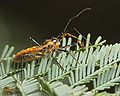 Gminatus australis with Beetle
 -
 Architeuthis beak
 -
 Convolvulus hawk-moth (Agrius convolvuli)
 -
 Wolf cranium labelled
 -
 Istiophorus platypterus
.jpg)


_2.jpg)


