Nasal vaccine: Difference between revisions
CSV import Tags: mobile edit mobile web edit |
CSV import |
||
| Line 28: | Line 28: | ||
{{pharmacology-stub}} | {{pharmacology-stub}} | ||
<gallery> | |||
File:GI_receives_an_intranasal_mist_of_the_flu_vaccine_at_Guantanamo.jpg|A person receiving an intranasal mist of the flu vaccine | |||
File:Nose_Anatomy.png|Anatomy of the human nose | |||
File:14234CDC_Flumist.tif|Flumist vaccine | |||
File:Fluenz_Tetra_for_2020_-_21_season.jpg|Fluenz Tetra vaccine for 2020-21 season | |||
File:SARS-CoV-2_without_background.png|SARS-CoV-2 virus illustration | |||
File:Bordetella_bronchiseptica.jpg|Bordetella bronchiseptica bacteria | |||
File:Nasal_Spray_(46057881342).jpg|Nasal spray | |||
</gallery> | |||
Latest revision as of 11:16, 18 February 2025
Nasal Vaccine
A nasal vaccine is a type of vaccine that is administered through the nose. Unlike traditional injectable vaccines, nasal vaccines are typically sprayed into the nostrils. They are designed to induce a response from the immune system in the mucous membranes of the nasal passages, which are often the first point of contact for pathogens.
Mechanism of Action[edit]
Nasal vaccines work by introducing a weakened or inactivated form of a pathogen, or a piece of the pathogen, into the nasal passages. This stimulates the immune system to produce a response, including the production of antibodies. These antibodies can then recognize and fight off the pathogen if the individual is exposed to it in the future.
Advantages[edit]
There are several advantages to nasal vaccines. They are non-invasive and easy to administer, which can be particularly beneficial in mass vaccination campaigns. They also mimic natural infection more closely than injectable vaccines, potentially leading to a more robust immune response. Furthermore, because they target the mucous membranes, they may be more effective at preventing respiratory diseases, which often enter the body through the nasal passages.
Disadvantages[edit]
However, nasal vaccines also have some disadvantages. They may not be suitable for everyone, including people with certain underlying health conditions or allergies. They may also be less effective than injectable vaccines at inducing a systemic immune response.
Examples[edit]
One example of a nasal vaccine is the FluMist influenza vaccine. This is a live attenuated vaccine that is sprayed into the nostrils. Another example is the nasal COVID-19 vaccine currently being developed by several companies, which aims to provide protection against the SARS-CoV-2 virus.
Future Research[edit]
Future research into nasal vaccines is focused on improving their efficacy and safety, as well as developing nasal vaccines for a wider range of diseases. This includes research into new adjuvants, which are substances that enhance the body's immune response to vaccines.

-
 A person receiving an intranasal mist of the flu vaccine
 -
 Anatomy of the human nose
 -
 Flumist vaccine
 -
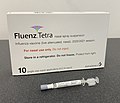 Fluenz Tetra vaccine for 2020-21 season
 -
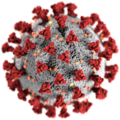 SARS-CoV-2 virus illustration
 -
 Bordetella bronchiseptica bacteria
 -
 Nasal spray


.jpg)
