Pithecellobium: Difference between revisions
CSV import Tags: mobile edit mobile web edit |
CSV import |
||
| Line 29: | Line 29: | ||
[[Category:Pithecellobium]] | [[Category:Pithecellobium]] | ||
{{Fabaceae-stub}} | {{Fabaceae-stub}} | ||
<gallery> | |||
File:Cayos_pict098.jpg|Pithecellobium | |||
File:Starr_070206-4139_Pithecellobium_dulce.jpg|Pithecellobium dulce | |||
</gallery> | |||
Latest revision as of 01:47, 18 February 2025
Pithecellobium is a genus of flowering plants in the legume family, Fabaceae. It belongs to the subfamily Mimosoideae. The genus is native to tropical regions of the Americas and is known for its ornamental and timber uses.
Description[edit]
The genus Pithecellobium comprises approximately 70 species of trees and shrubs. The plants in this genus are characterized by their bipinnate leaves, small flowers arranged in globular heads, and flat, twisted seed pods. The seed pods often have a sweet pulp that is edible and used in traditional medicine in some cultures.
Distribution and Habitat[edit]
Pithecellobium is native to tropical and subtropical regions of the Americas, from Mexico and the Caribbean south to Argentina. The plants are typically found in lowland forests and savannas, and some species are adapted to dry, desert-like conditions.
Uses[edit]
Many species of Pithecellobium are used for their timber, which is hard and durable. The wood is often used in construction and furniture making. Some species are also grown as ornamental plants for their attractive foliage and flowers. The sweet pulp of the seed pods is edible and is sometimes used in traditional medicine.
Species[edit]
Some of the notable species in the Pithecellobium genus include:
- Pithecellobium dulce, also known as the Manila tamarind
- Pithecellobium flexicaule, also known as the Texas ebony
- Pithecellobium keyense, also known as the Florida Keys blackbead
See Also[edit]
References[edit]
<references />

-
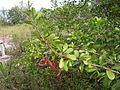 Pithecellobium
 -
 Pithecellobium dulce


