Crus of diaphragm: Difference between revisions
CSV import Tags: mobile edit mobile web edit |
CSV import |
||
| Line 30: | Line 30: | ||
[[Category:Respiratory system]] | [[Category:Respiratory system]] | ||
{{anatomy-stub}} | {{anatomy-stub}} | ||
== Crus of diaphragm gallery == | |||
<gallery> | |||
File:Gray391.png|Gray391 | |||
</gallery> | |||
Latest revision as of 05:15, 3 March 2025
Crus of diaphragm refers to the two tendinous structures that extend inferiorly from the diaphragm, a muscle that plays a crucial role in respiration. The crura (plural of crus) anchor the diaphragm to the vertebral column.
Anatomy[edit]
The diaphragm is a dome-shaped muscle that separates the thoracic cavity from the abdominal cavity. The crura are located at the posterior aspect of the diaphragm. There are two crura - the right crus and the left crus.
The right crus is larger and longer than the left. It arises from the anterior surfaces of the bodies and intervertebral fibrocartilage of the upper three lumbar vertebrae.
The left crus arises from the bodies of the upper two lumbar vertebrae.
The crura are connected to each other by the median arcuate ligament.
Function[edit]
The primary function of the crura is to provide points of attachment for the diaphragm. They help in stabilizing the position of the diaphragm, preventing it from being pushed up into the thoracic cavity when the abdominal muscles contract.
The crura also play a role in the opening and closing of the esophageal hiatus, the opening in the diaphragm through which the esophagus passes.
Clinical significance[edit]
Abnormalities or injury to the crura can lead to conditions such as hiatal hernia, where a part of the stomach pushes up through the esophageal hiatus into the chest.
See also[edit]

Crus of diaphragm gallery[edit]
-
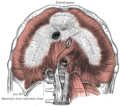 Gray391

