Thlaspi arvense: Difference between revisions
CSV import Tags: mobile edit mobile web edit |
CSV import |
||
| Line 23: | Line 23: | ||
[[Category:Brassicaceae]] | [[Category:Brassicaceae]] | ||
{{Flora-stub}} | {{Flora-stub}} | ||
<gallery> | |||
File:Thlaspi_arvense.jpeg|Thlaspi arvense plant | |||
File:CC-BY_icon.svg|Creative Commons BY icon | |||
File:Thlaspiseed.jpg|Thlaspi arvense seeds | |||
</gallery> | |||
Latest revision as of 01:50, 18 February 2025
Thlaspi arvense, commonly known as Field Pennycress, is a flowering plant species in the family Brassicaceae. It is native to Eurasia but is known globally as an introduced species and often a noxious weed.
Description[edit]
Thlaspi arvense is an annual herb with a smooth stem growing 10 to 80 centimeters tall. The leaves are lance-shaped and are borne in a rosette at the base of the plant, with smaller leaves occurring up the stem. The flowers are borne in a dense raceme, and have four white petals. The fruit is a round, flat silique containing several seeds.
Distribution and habitat[edit]
Thlaspi arvense is native to Eurasia, but has been introduced to North America, where it is often found as a weed in fields, gardens, and disturbed sites. It prefers well-drained soils and can tolerate a range of pH levels.
Uses[edit]
Despite its status as a weed, Thlaspi arvense has several uses. Its seeds have been used to produce oil, and it has been used in traditional medicine to treat various ailments. It is also a food source for several species of Lepidoptera.
Ecology[edit]
Thlaspi arvense is a host plant for several species of aphids, and is a food source for several species of Lepidoptera. It can also act as a reservoir for plant viruses.
See also[edit]
References[edit]
<references />

This flora-related article is a stub. You can help WikiMD by expanding it.
-
 Thlaspi arvense plant
 -
 Creative Commons BY icon
 -
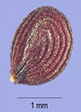 Thlaspi arvense seeds


