Ocean sunfish: Difference between revisions
CSV import |
CSV import |
||
| Line 36: | Line 36: | ||
{{Marine-biology-stub}} | {{Marine-biology-stub}} | ||
{{Conservation-biology-stub}} | {{Conservation-biology-stub}} | ||
<gallery> | |||
File:Mola_mola.jpg|Ocean sunfish | |||
File:Mola_mola2.jpg|Ocean sunfish | |||
File:Molalavdj.jpg|Ocean sunfish | |||
File:Mola_mola-Skelett,_Naturhistorisches_Museum_Wien.jpg|Ocean sunfish skeleton at the Natural History Museum, Vienna | |||
File:GFNMS_--_Mola_Mola_(35221024103).jpg|Ocean sunfish | |||
File:Enormous_Sunfish.jpg|Enormous ocean sunfish | |||
File:Mola_mola_ocean_sunfish_Monterey_Bay_Aquarium_2.jpg|Ocean sunfish at Monterey Bay Aquarium | |||
File:Mondfisch_Ozenarium_Lissabon_20090228.ogv|Ocean sunfish video | |||
</gallery> | |||
Latest revision as of 12:18, 18 February 2025
Ocean Sunfish
The Ocean Sunfish (Mola mola), also known as the common mola, is a species of fish belonging to the family Molidae. It is the heaviest known bony fish in the world, with adults typically weighing between 247 and 1,000 kg. The species is native to the tropical and temperate waters of every ocean in the world.
Description[edit]
The Ocean Sunfish has a unique shape, with a flattened body and a dorsal fin that extends high above its body. Its skin is thick and rough, and it is usually a gray to brown color. The fish has a small mouth and its teeth are fused into a beak-like structure.
Habitat and Distribution[edit]
The Ocean Sunfish is found in tropical and temperate waters around the world. It prefers open water but can also be found near the coast, especially in areas with deep water close to shore. The species is known to dive to depths of up to 600 meters to search for food.
Diet[edit]
The diet of the Ocean Sunfish consists mainly of jellyfish, but it also eats small fish, plankton, and algae. Despite its large size, the sunfish is not a threat to humans and is considered harmless.
Reproduction[edit]
The Ocean Sunfish is known for its high fecundity, with females capable of producing more eggs than any other known vertebrate. The eggs are released into the water and fertilized externally. The larvae are planktonic and undergo a complex development before reaching adult size.
Conservation Status[edit]
The Ocean Sunfish is currently listed as Vulnerable by the International Union for Conservation of Nature (IUCN). The main threats to the species are bycatch in fisheries and pollution.
See Also[edit]

| This marine biology related article is a stub. You can help WikiMD by expanding it. |
This article is a Conservation biology-related stub. You can help WikiMD by expanding it!
-
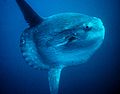 Ocean sunfish
 -
 Ocean sunfish
 -
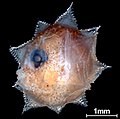 Ocean sunfish
 -
 Ocean sunfish skeleton at the Natural History Museum, Vienna
 -
 Ocean sunfish
 -
 Enormous ocean sunfish
 -
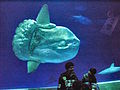 Ocean sunfish at Monterey Bay Aquarium
 -
 Ocean sunfish video


.jpg)


