Mirabilis jalapa: Difference between revisions
CSV import |
CSV import |
||
| Line 22: | Line 22: | ||
[[Category:Medicinal plants]] | [[Category:Medicinal plants]] | ||
{{Flora-stub}} | {{Flora-stub}} | ||
<gallery> | |||
File:Gul-Abas-4-O'clock_plant.JPG|Gul-Abas 4 O'clock plant | |||
File:Seed_of_mirabilis_jalapa.JPG|Seed of mirabilis jalapa | |||
File:Intermediate_inheritance_-_incomplete_dominance.png|Intermediate inheritance - incomplete dominance | |||
File:Seed_of_mirabilis_jalapa.JPG|Seed of mirabilis jalapa | |||
File:4_o'clock_blooms.jpg|4 o'clock blooms | |||
File:Mirabilis-jalapa-In-Different-Colors.jpg|Mirabilis jalapa in different colors | |||
File:4_o'clock_1.jpg|4 o'clock 1 | |||
File:4_o'clock_2.jpg|4 o'clock 2 | |||
File:Belle_de_Nuit.jpg|Belle de Nuit | |||
File:Mirabilis_jalapa_678.JPG|Mirabilis jalapa 678 | |||
File:Mirabilis_jalpa.jpg|Mirabilis jalpa | |||
File:Mirabilis_jalapa_(Nyctaginaceae)_-_pink_and_white.jpg|Mirabilis jalapa (Nyctaginaceae) - pink and white | |||
File:Mirabilis_jalapa_(Nyctaginaceae)_-_stamens_and_pistil.jpg|Mirabilis jalapa (Nyctaginaceae) - stamens and pistil | |||
</gallery> | |||
Latest revision as of 21:25, 20 February 2025
Mirabilis jalapa, also known as the marvel of Peru or four o'clock flower, is a species of flowering plant in the family Nyctaginaceae. It is native to tropical South America but has been naturalized throughout tropical and warm temperate regions worldwide.
Description[edit]
Mirabilis jalapa is a perennial herb that grows up to 1 meter in height. The leaves are opposite, simple, and ovate, measuring 4–12 cm long. The flowers are fragrant, trumpet-shaped, and can be white, red, yellow, or pink. They typically open in the late afternoon (hence the common name "four o'clock flower") and close in the morning.
Cultivation[edit]
Mirabilis jalapa is often grown as an ornamental plant for its attractive flowers. It prefers full sun to partial shade and well-drained soil. The plant is propagated by seeds, which can be sown directly in the garden in spring.
Uses[edit]
In addition to its use as an ornamental plant, Mirabilis jalapa has been used in traditional medicine. The plant is reported to have diuretic, purgative, and vulnerary properties. However, all parts of the plant are considered toxic if ingested in large quantities.
Cultural Significance[edit]
In many cultures, Mirabilis jalapa is associated with various myths and folklore. For example, in some parts of India, the plant is believed to ward off evil spirits.
See Also[edit]

This flora-related article is a stub. You can help WikiMD by expanding it.
-
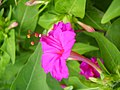 Gul-Abas 4 O'clock plant
 -
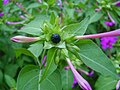 Seed of mirabilis jalapa
 -
 Intermediate inheritance - incomplete dominance
 -
Seed of mirabilis jalapa
-
 4 o'clock blooms
 -
 Mirabilis jalapa in different colors
 -
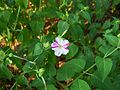 4 o'clock 1
 -
 4 o'clock 2
 -
 Belle de Nuit
 -
 Mirabilis jalapa 678
 -
 Mirabilis jalpa
 -
 Mirabilis jalapa (Nyctaginaceae) - pink and white
 -
 Mirabilis jalapa (Nyctaginaceae) - stamens and pistil


_-_pink_and_white.jpg)
_-_stamens_and_pistil.jpg)
